


TL;DR:
- Vocabulary acquisition involves distinct stages from noticing to active production, requiring tailored effort.
- Combining structured lessons, spaced repetition, and contextual practice accelerates fluency for Singapore learners.
- Avoid common pitfalls like false friends and the receptive-productive gap through deliberate practice and grammar integration.
Vocabulary retention is the silent barrier that stops many Singapore learners from reaching fluency in Spanish. You can sit through lessons, download apps, and memorize flashcards, yet still find yourself drawing a blank the moment a native speaker says something unexpected. The frustration is real, and it’s common. But the gap between passive vocabulary exposure and active, confident usage is not permanent. With a structured, evidence-backed approach tailored to how adults in Singapore actually learn, you can close that gap faster than you think. This guide walks you through every stage of Spanish vocabulary acquisition, from foundational steps to fluency verification.
Table of Contents
- Understanding the stages of Spanish vocabulary acquisition
- Essential tools and strategies for building Spanish vocabulary
- Overcoming common mistakes and vocabulary pitfalls
- Verifying your progress and achieving contextual fluency
- Why combining structured and incidental learning is key
- Accelerate your Spanish vocabulary journey in Singapore
- Frequently asked questions
Key Takeaways
| Point | Details |
|---|---|
| Follow acquisition stages | Learning Spanish vocabulary is most effective when you progress through noticing, mapping, consolidation, and production. |
| Combine methods for fluency | Spaced repetition and contextual practice together drive higher retention and usable language skills. |
| Set and verify milestones | Track progress via certification exams or conversational ability to stay motivated and ensure skills are practical. |
| Avoid common pitfalls | False friends and receptive gaps can hinder progress, so actively address them with proven strategies. |
| Structured courses accelerate progress | Enrolling in certified Spanish classes in Singapore helps organize your learning for both personal and professional goals. |
Understanding the stages of Spanish vocabulary acquisition
With the importance of structured learning established, we’ll clarify the core stages you’ll encounter as you build your Spanish vocabulary.
Learning Spanish vocabulary is not a single event. It’s a process that moves through several distinct stages, and knowing where you are in that process helps you choose the right method at the right time. Research on vocabulary acquisition stages identifies five key phases: noticing, form-meaning mapping, consolidation through spaced repetition, contextualization, and production. Each stage requires a different kind of effort, and skipping one often leads to words that “stick” in recognition but vanish under conversational pressure.
Noticing is simply becoming aware that a word exists. You hear “querer” (to want or to love) in a sentence and register it. Form-meaning mapping is when you connect that sound or spelling to its definition. Consolidation is where most learners struggle. This is where spaced repetition systems (SRS), tools that schedule reviews at strategic intervals to beat forgetting, make the biggest difference. Contextualization means seeing the word used across multiple settings, in a restaurant menu, a text message, a news headline. Finally, production is using the word yourself, spontaneously and correctly.
Here is how proficiency levels generally align with vocabulary size:
| Proficiency level | Vocabulary range | Communication ability |
|---|---|---|
| A1 (Beginner) | 500 to 800 words | Greetings, basic needs |
| A2 (Elementary) | 800 to 1,500 words | Simple transactions, descriptions |
| B1 (Intermediate) | 1,500 to 3,000 words | Travel, work conversations |
| B2 (Upper Intermediate) | 3,000 to 6,000 words | Academic and professional use |
| C1/C2 (Advanced) | 6,000 to 10,000+ words | Near-native fluency |
One critical benchmark every Singapore learner should know: 600 to 750 hours of dedicated study is typically required to reach B2 or C1 proficiency. That sounds like a lot, but spread across a structured course, it’s two to three years of consistent practice. For daily conversation, focusing first on the top 1,000 most-used words covers the vast majority of what you’ll encounter in real speech.
There is also a key distinction between incidental learning (picking up words through reading and listening without deliberate focus) and intentional learning (deliberate study of vocabulary lists or structured lessons). Both are necessary, but beginners in Singapore tend to rely too heavily on incidental exposure through apps and media while underestimating the power of intentional, structured progression.
Building a strong base in daily use vocabulary early on creates the scaffolding that makes all future learning faster. Think of it like learning the frame of a house before decorating the rooms. Once you know your foundational words well, new vocabulary fits itself into patterns you already recognize. And having a clear workflow for learning Spanish ensures that your daily effort compounds rather than repeats itself without progress.
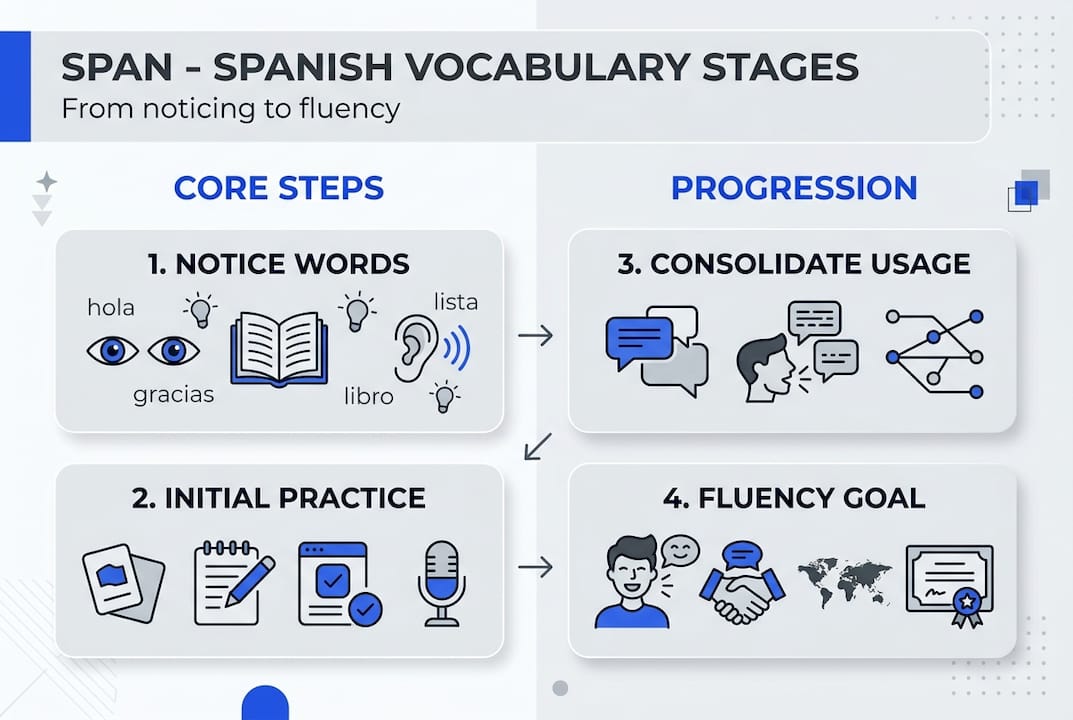
Understanding the progression also removes a major source of discouragement. When you know you’re at the consolidation stage and that it requires repetition over weeks rather than hours, you stop expecting overnight results. That mindset shift alone dramatically improves long-term outcomes.
Essential tools and strategies for building Spanish vocabulary
Knowing the stages, it’s time to set up your toolkit for learning and decide which strategies match your goals and schedule.
Not all vocabulary tools are created equal, and the research makes this very clear. Spaced retrieval practice shows statistically significant fluency gains in A1 learners, with improvements measured at a p-value of 0.015, meaning the effect is unlikely to be due to chance. Meanwhile, apps alone tend to fall short. Contextual and spaced learning scores 94 out of 100 on effective fluency measures, while app-only approaches score just 61 out of 100. Apps build habits, but they rarely build conversational confidence on their own.
Here is a practical comparison of common vocabulary tools used by Singapore learners:
| Tool/Method | Best for | Contextual fluency | Consistency support |
|---|---|---|---|
| Language apps (e.g., Duolingo) | Daily habit, exposure | Low | High |
| Physical flashcards | Targeted recall | Low to medium | Medium |
| SRS software (e.g., Anki) | Long-term retention | Medium | High |
| Group Spanish classes | Contextual practice | High | High |
| Private instruction | Personalized gaps | Very high | High |
The most effective learners in Singapore combine more than one method. Here’s a practical daily routine you can follow:
- Morning review (10 minutes): Use an SRS app to review due flashcards. Focus on words flagged as forgotten.
- Midday exposure (15 minutes): Read one short Spanish article or listen to a five-minute podcast episode. Don’t translate every word. Let context do the work.
- Evening practice (20 to 30 minutes): Attend a class, watch a Spanish show, or write three sentences using new words from the day.
- Weekly reflection (10 minutes): Review which words you’re still missing. Group them by topic and create example sentences.
Pro Tip: Instead of learning words in isolation, always pair new vocabulary with a memorable sentence from your own life. For example, don’t just memorize “reunión” (meeting). Write: “Tengo una reunión a las dos” (I have a meeting at two). The personal connection makes the word stick far longer than a definition alone.
When it comes to learning more quickly, a structured classroom environment offers something no app can replicate: real-time feedback. You find out immediately when you use the wrong word order or misapply a verb conjugation. That feedback loop speeds up the correction process significantly. Learners who want to learn Spanish fast in Singapore consistently benefit from working with certified Spanish teachers who can identify patterns in your errors and address them directly. No algorithm does that as effectively as an experienced human instructor.
Overcoming common mistakes and vocabulary pitfalls
Even with strong routines, some challenges are unique to Spanish. Here’s how to turn these hurdles into opportunities.
Spanish has a reputation for being relatively accessible to English speakers, and in many ways that’s true. But this reputation creates overconfidence that leads to specific, avoidable mistakes. Knowing the pitfalls in advance puts you well ahead of most self-taught learners.
False friends are the most notorious trap. These are words that look or sound similar to English words but mean something entirely different. The word “molestar” in Spanish means to bother or annoy, not what the English word “molest” suggests. “Embarazada” means pregnant, not embarrassed. “Sensible” in Spanish means sensitive, not sensible. These false friends and polysemy issues (where one word carries multiple meanings depending on context) are documented causes of serious miscommunication.
Here are the most common vocabulary mistakes Singapore learners make:
- Translating word-for-word from English without accounting for Spanish word order
- Learning only the most common meaning of a word and being confused when it appears in a different context
- Neglecting collocations, meaning word pairs that naturally go together, such as “tomar una decisión” (make a decision) rather than “hacer una decisión”
- Ignoring register, which is the level of formality. Knowing “comer” is fine for everyday use, but “degustar” is used in formal dining contexts
- Building a large receptive vocabulary (words you recognize when reading or listening) without an equally strong productive vocabulary (words you can actually use when speaking or writing)
The receptive-productive gap is especially common among learners who rely heavily on reading and passive listening. You may recognize hundreds of words but freeze when asked to use them in conversation. Closing this gap requires deliberate production practice: speaking, writing, and being corrected.
“Transparent orthography in Spanish emphasizes phonological and morphological awareness as key tools for acquiring new vocabulary efficiently.” This means Spanish spelling closely reflects pronunciation, so building strong phonological awareness (the ability to hear and identify word sounds) gives you a significant advantage when encountering unfamiliar words.
Pro Tip: When you encounter a new word, don’t just note its meaning. Look it up in a Spanish sentence, identify what words it commonly appears with (collocations), and note whether it’s formal or casual. This three-step check takes 60 extra seconds and dramatically improves retention and correct usage.
Investing time in Spanish grammar essentials alongside vocabulary will also help you catch false assumptions early. Grammar and vocabulary are deeply connected in Spanish, and understanding why a sentence is structured a certain way helps you use your vocabulary correctly and creatively. Singapore learners also benefit from the fact that English enhances Spanish instruction in bilingual environments, making it easier to explain nuance and catch false friends before they become habits.
Verifying your progress and achieving contextual fluency
To make your vocabulary work for you, it’s essential to track your improvements and connect your learning to real-world conversations.
Memorizing words is only meaningful if you can actually use them when it counts. Contextual fluency means your vocabulary is accessible under pressure, in conversation, in writing, and in listening. That requires a different approach than passive review.
Here’s how to set clear, measurable milestones for your vocabulary progress:
- Week one to four: Learn 10 new words per day from a frequency list. By the end of the month, you should have 300 new words, all reviewed at least three times.
- Month two to three: Shift focus to learning words in themed clusters (food, travel, work, emotions). Use each cluster in at least five written sentences.
- Month four to six: Begin conversational practice sessions. Track how many new words you use naturally without looking them up.
- Month seven onward: Prepare for a formal language exam or join a conversation group to simulate real-world usage.
Research confirms that 600 to 750 hours of focused study leads to B2 or C1 proficiency, but the quality of those hours matters as much as the quantity. Passive screen time counts far less than active speaking or structured review.
Here is a summary of progress verification methods and what each one tells you:
| Verification method | What it measures | Practical use |
|---|---|---|
| SRS app data | Words retained over time | Adjust study frequency |
| Certification exam (DELE/SIELE) | Formal proficiency level | Academic or professional proof |
| Conversation with native speakers | Real-time production ability | Identify gaps apps miss |
| Journaling in Spanish | Productive vocabulary range | Spot overused or missing words |
| Self-recorded speaking samples | Fluency and word variety | Track improvement over months |
Contextual fluency differs fundamentally from memorization. You may have memorized the definition of “imprescindible” (indispensable), but contextual fluency means you use it naturally when discussing a project at work. To get there, regular Spanish speaking practice is non-negotiable. It’s the bridge between knowing and doing.
One often-overlooked decision is whether to focus on Latin American Spanish versus Spain Spanish. For Singapore learners with professional interests in Latin America, this choice affects which vocabulary, expressions, and accents you prioritize. Making this decision early in your learning journey prevents the confusion that comes from mixing vocabulary registers from different regions.
Why combining structured and incidental learning is key
Most learners choose a side. They either commit to a rigorous study plan or rely on immersive, organic exposure through media and social contact. But the evidence, and our experience working with Singapore learners across all levels, suggests that this is a false choice.
Krashen’s comprehensible input theory (the idea that we acquire language best when exposed to content just slightly above our current level, known as i+1) is powerful for contextualizing vocabulary. But without explicit, intentional study through SRS and structured classroom work, progress stalls. The learner is always recognizing but rarely producing.
Real fluency lives at the intersection of both. Structured classroom instruction gives you the consistency and accountability that self-directed learning often lacks. It also gives you a qualified human who catches patterns in your errors before they become entrenched habits. Incidental exposure through podcasts, films, and conversation fills in the cultural texture that no textbook fully captures.
The biggest mistake we see is treating these approaches as alternatives rather than complements. An efficient Spanish workflow blends both: structured lessons three to four times per week, and daily low-stakes exposure through media or conversation for 15 to 20 minutes. Neither alone gets you to fluency. Together, they do.
Pro Tip: Set a daily “input hour” separate from your study sessions. Listen to Spanish radio, watch a Spanish cooking show, or text a language exchange partner. Don’t treat this as studying. Let it be enjoyable. That psychological separation makes it sustainable, and sustainability is what produces fluency.
Accelerate your Spanish vocabulary journey in Singapore
If you’re ready to put your vocabulary learning into action, these resources in Singapore can help you get started.
At Spanish Explorer, our curriculum is built around exactly the principles covered in this guide: structured progression, certified instruction, and real-world contextual practice. Whether you’re a complete beginner or looking to push past an intermediate plateau, our Spanish courses in Singapore are designed to move you efficiently through each stage of vocabulary acquisition. For learners with specific goals or scheduling needs, private Spanish instruction offers personalized attention that accelerates results. And when you’re ready to formally validate your progress, our DELE Spanish exam preparation gives you a recognized, internationally accepted credential. Take the next step with structured guidance from certified instructors who understand how Singapore learners think and learn.
Frequently asked questions
How many Spanish words should I learn first for basic communication?
Start with the top 1,000 most-used Spanish words, which cover the vast majority of everyday conversations and provide a strong foundation before expanding into specialized vocabulary.
What is the average time needed for B2 or C1 Spanish proficiency?
Most learners need 600 to 750 hours of focused study to reach B2 or C1 proficiency, though the quality and structure of those hours significantly affect how quickly you progress.
What are false friends in Spanish and how can I avoid mistakes?
False friends are Spanish words that resemble English words but carry different meanings, such as “molestar” meaning to bother, not what the English equivalent implies. Always verify unfamiliar cognates in a Spanish-language dictionary with example sentences.
Which method is most effective: apps, flashcards, or classroom learning?
No single method wins on its own. Contextual plus spaced learning scores significantly higher than app-only approaches, so combining structured classroom instruction with spaced repetition tools delivers the best results for contextual fluency.
Sorry, the comment form is closed at this time.