 Spanish
TL;DR:
- Low-stakes, structured activities like information gaps and quizzes build confidence and fluency.
- Matching activities to learner age, motivation, environment, and learning style increases effectiveness.
- Consistent repetition in a safe environment is more impactful than novelty for improving spoken Spanish.
Finding Spanish speaking activities that actually move the needle is harder than it sounds. Most learners in Singapore try a few vocabulary apps, sit through some drills, and still freeze the moment a native speaker says ¿Cómo estás? The gap between knowing words and speaking them confidently is real, and it is frustrating. What bridges that gap is not more memorization. It is structured, low-stakes interaction that builds muscle memory and confidence at the same time. This article walks you through proven activity types, selection criteria, and a practical comparison so you can choose what works for your level, learning style, and schedule.
Table of Contents
- Choosing the right Spanish speaking activity
- Top examples: Low-pressure paired and group activities
- Task-based strategies for real-life communication
- Comparing Spanish speaking activities: Pros and cons
- Our expert take: What actually builds spoken fluency
- Take the next step: Structured Spanish courses in Singapore
- Frequently asked questions
Key Takeaways
| Point | Details |
|---|---|
| Low-stakes practice | Activities that reduce pressure and allow repeated speaking help build confidence and fluency. |
| Task-based methods | Using real-life scenarios for speaking practice leads to more authentic communication. |
| Adapt for learning style | Introverts and kinesthetic learners benefit from customized activities and formats. |
| Mix activity types | Combining group, pair, and task-based activities fosters all-around spoken Spanish skills. |
Choosing the right Spanish speaking activity
Not every speaking activity fits every learner. Before you pick one, it helps to think through a few key variables that determine whether an activity will actually stick.
Age and proficiency level are the most obvious filters. A teenager in a group class benefits from fast-paced games that keep energy high. An adult professional learning Spanish for work needs activities that mirror real conversations, like negotiating, presenting, or making small talk. Beginners need repetition and predictable structures. Intermediate learners need to be pushed into less scripted territory.
Learning style matters more than most people admit. Auditory learners thrive with listening-and-repeat formats or conversation circles. Kinesthetic learners, those who learn by doing, engage better with movement-based tasks or hands-on card games. Introverts often shut down in high-pressure group formats but do well with one-on-one paired tasks where the audience is small and the stakes feel lower.
Environment shapes your options too. In a classroom, you can run group games, partner rotations, and physical activities. In a solo study setup at home, you need to adapt: record yourself, use language exchange apps, or join virtual conversation groups. The key is not to let environment become an excuse to skip speaking practice altogether.
Here is what to look for in any good speaking activity:
- Low stakes: mistakes are expected and not penalized
- Repetition: you say the same structure multiple times in different contexts
- Interaction: there is a real communicative purpose, not just recitation
- Adaptability: it works across levels with minor tweaks
- Engagement: it holds attention for more than five minutes
The research backs this up. Low-stakes activities prioritize volume of practice over perfection, which contrasts sharply with high-pressure drills that make learners clam up. Task-based language teaching (TBLT), a method where learners use language to complete real communicative goals, also emphasizes the output hypothesis, the idea that producing language, not just consuming it, is what drives fluency gains.
For more speaking practice ideas tailored to Singapore learners, it helps to start with activities that match your current comfort level and then gradually increase the challenge.
Pro Tip: If you are unsure where to start, pick the activity that feels slightly uncomfortable but not overwhelming. That edge zone is where real learning happens.
Top examples: Low-pressure paired and group activities
With criteria established, let’s look at the most effective paired and group activities that Spanish teachers recommend for building confidence without the pressure.
Information gap activities are a classic for good reason. Two learners each hold different pieces of information and must speak Spanish to fill in the gaps. Neither person can complete the task alone, so the interaction is genuine. This format works brilliantly for practicing question forms, numbers, schedules, and descriptions.
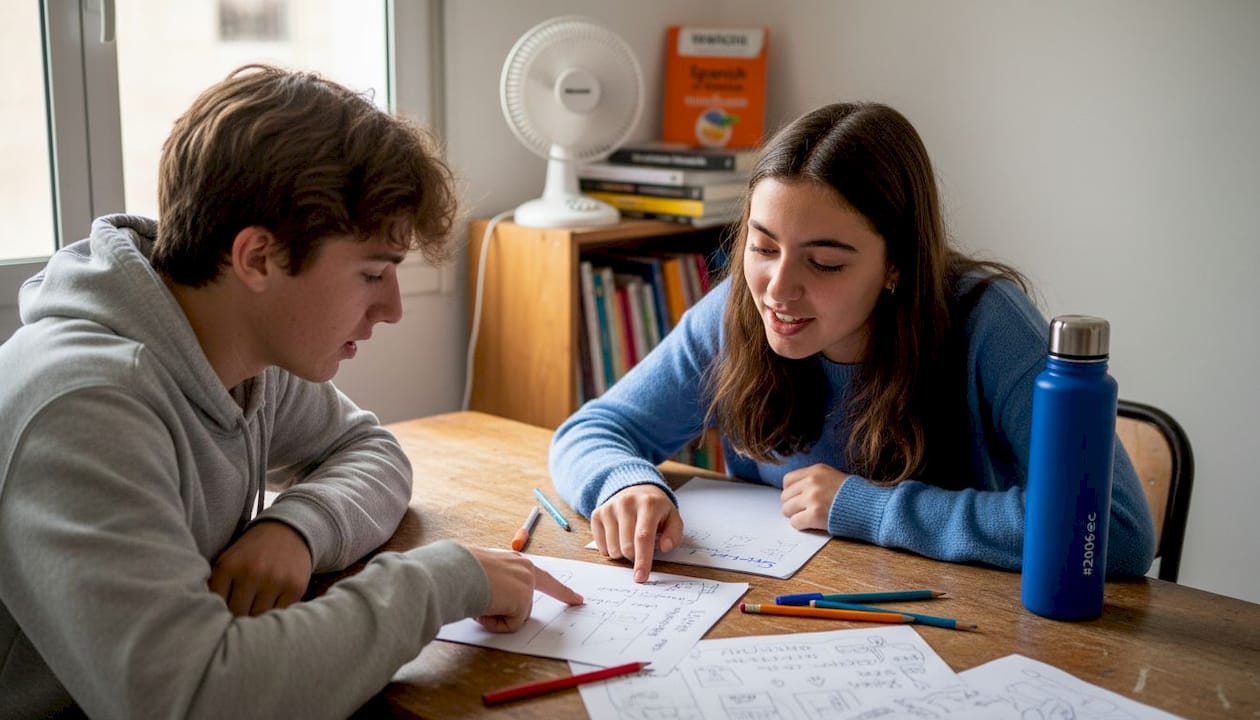
Quiz Quiz Trade is a fast-moving card game where learners quiz each other, swap cards, and move on to a new partner. The repetition is built in, and the movement keeps energy levels up. It is especially effective in group classes because every student speaks multiple times in a short window.
Running dictation takes learners out of their seats. One partner reads a posted text from across the room, walks back, and dictates it to their partner who writes it down. It combines listening, speaking, memory, and movement in one activity. Kinesthetic learners love it.
Strip bingo replaces numbers with vocabulary words or phrases. As the teacher or a student calls out clues in Spanish, players mark their cards. It is a gentle icebreaker that works well at the start of a lesson and helps introverts ease into speaking without being put on the spot.
Here is a quick summary of paired and group activity formats:
- Information gap: builds question-and-answer fluency through genuine need
- Quiz Quiz Trade: high repetition, social, great for vocabulary review
- Running dictation: kinesthetic, combines multiple skills
- Strip bingo: low pressure, ideal for warm-ups and introverts
- Cognates game: uses shared Spanish-English words to build early confidence
Experienced Spanish teachers know that low-stakes speaking activities like these build confidence through repetition and real interaction, not through fear of correction. Many of these formats translate well to online learning too. Breakout rooms on Zoom or Google Meet replicate the paired format almost perfectly.
If you are exploring Spanish courses in Singapore, look for programs that incorporate these activity types into regular lessons rather than relying purely on textbook drills. And if you are just getting started with learning Spanish in Singapore, these formats are a practical way to build early momentum.
Pro Tip: For online self-study, record yourself doing a solo version of information gap using two different character cards. Play both roles out loud. It feels awkward at first but builds fluency fast.
Task-based strategies for real-life communication
Alongside paired activities, task-based strategies form the foundation for meaningful Spanish conversation practice that goes beyond the classroom.
Task-based language teaching (TBLT) is built on one core idea: learners acquire language more effectively when they use it to accomplish something real. Instead of drilling conjugations in isolation, you practice Spanish by completing a task that requires those conjugations naturally. The language becomes a tool, not the subject itself.
Here are four TBLT-style activities that work well for Singapore learners:
- Role-play scenarios: Simulate a restaurant order, a job interview, or asking for directions in a Spanish-speaking city. These recreate authentic communicative situations and force you to think on your feet.
- Peer interviews: One learner interviews another using a prepared set of questions. This builds both asking and answering skills and creates a natural conversational rhythm.
- Storytelling with circling questions: A teacher or partner tells a simple story in Spanish and asks repeated comprehension questions in varied forms. This technique, drawn from TPRS (Teaching Proficiency through Reading and Storytelling), pairs comprehensible input with speaking output for strong retention.
- Problem-solving tasks: Learners discuss a scenario in Spanish and must agree on a solution. This pushes intermediate and advanced learners into negotiation and opinion language.
The output hypothesis behind TBLT is clear: producing language, not just receiving it, is what accelerates fluency. And circling questions are especially powerful because they provide comprehensible input before demanding output, lowering the cognitive load on the learner.
“The most effective speaking practice happens when learners are focused on meaning and communication, not on the correctness of their grammar. Fluency follows when the pressure to be perfect is removed.”
This approach aligns closely with the structured fluency approach used at Spanish Explorer, where lessons are designed to build real communicative competence rather than just grammatical knowledge. For learners who prefer flexibility, these task-based formats also adapt well to an online Spanish class environment.
Comparing Spanish speaking activities: Pros and cons
To decide which activity fits your needs, consider these side-by-side comparisons before committing to a format.
| Activity | Format | Best for | Pros | Cons |
|---|---|---|---|---|
| Information gap | Paired | Beginners, intermediates | Genuine interaction, structured | Needs a partner |
| Quiz Quiz Trade | Group | All levels | High repetition, energetic | Requires printed cards |
| Running dictation | Group/paired | Kinesthetic learners | Multi-skill, engaging | Needs physical space |
| Role-play | Paired/solo | Intermediates, advanced | Authentic scenarios | Can feel awkward at first |
| Circling/TPRS | Group/class | Beginners, visual learners | Strong input-output balance | Teacher-led, less self-study friendly |
| Strip bingo | Group | Beginners, introverts | Low stakes, easy to set up | Limited speaking output |
Choosing the right format also depends on your personality. Introverts benefit from icebreakers like the cognates game or strip bingo, while kinesthetic learners thrive with dice games and movement tasks. Knowing your type saves you from forcing yourself into formats that drain rather than energize you.
Here are some quick recommendations based on learner profile:
- Introverts: Start with strip bingo or cognates games, then move to paired information gap once comfortable
- Kinesthetic learners: Prioritize running dictation, dice games, and role-play with physical props
- Advanced learners: Focus on problem-solving tasks, peer interviews, and debate-style discussions
- Solo learners: Use role-play recordings, language exchange apps, and TPRS-style video content
Mixing two or three formats across a week gives you the best results. Variety prevents boredom and ensures you practice different skill sets. Pair a high-energy group activity with a quieter solo task for balance. You might also explore a Spanish dialects guide to understand which vocabulary to prioritize, and build your base with daily Spanish vocabulary before layering in more complex speaking tasks.
Our expert take: What actually builds spoken fluency
Most articles on Spanish speaking activities focus on novelty. New game formats, creative themes, clever setups. And while variety has its place, what we have seen consistently at Spanish Explorer is that the learners who improve fastest are not the ones doing the most interesting activities. They are the ones doing simple activities repeatedly in a safe environment.
Psychological safety is underrated. When a learner knows they will not be embarrassed for making a mistake, they speak more. They attempt harder sentences. They self-correct without shutting down. That environment matters more than the activity itself.
Low-stakes practice consistently outperforms high-pressure drills for building real fluency because volume of output, not perfection of output, is what rewires the brain. You do not need to say it right every time. You need to say it often.
Our recommendation: build a weekly speaking routine with two or three formats you already know, and only add new activities once those feel comfortable. Consistency beats novelty. That is the core of our teaching style at Spanish Explorer, and it is what separates learners who plateau from those who keep growing.
Take the next step: Structured Spanish courses in Singapore
Speaking activities are most powerful when they sit inside a structured learning framework that builds vocabulary, grammar, and confidence in parallel.
At Spanish Explorer, our Spanish courses are designed to integrate speaking practice into every lesson, not treat it as an afterthought. Whether you prefer group classes, private sessions, or a flexible Spanish class online, our certified instructors use task-based and low-stakes methods to accelerate your progress. If you have a specific goal like passing the DELE exam, we offer exam-focused preparation that builds both accuracy and spoken fluency. Take the next step and find a course that matches your level and schedule.
Frequently asked questions
What Spanish speaking activities work best for beginners?
Information gap games, paired speaking, and basic role-play are ideal for beginners as they emphasize low-pressure practice and repetition. These formats give beginners a clear structure to follow so they can focus on speaking rather than figuring out what to say.
How can introverts participate in Spanish speaking activities?
Icebreakers like cognates game, strip bingo, and circle-question formats help introverts warm up comfortably before paired or group practice. These low-exposure formats reduce the social pressure that often silences introverted learners.
What is task-based language teaching (TBLT)?
TBLT is a method where learners use Spanish to complete real-life tasks, which builds authentic communication skills and fluency. It shifts the focus from grammar rules to meaningful interaction, which accelerates real-world speaking ability.
Are these activities suitable for online learning?
Many speaking activities, including paired tasks and games, can be adapted for online platforms with breakout rooms and digital task cards. The core mechanics of interaction and repetition transfer well to virtual formats with minimal adjustment.
Recommended
- Top Spanish speaking practice ideas to boost skills in Singapore
- Spanish Courses in Singapore | Spanish Language Centre
- Spanish Courses in Singapore | Spanish Language Centre
- Spanish Class in Singapore: Learn Spanish Language with Spanish Explorer – Spanish Language School
Start Learning Spanish Today
Book a trial class and see how quickly you can progress with a professionally trained native-speaker teacher guiding the way.
Book a Trial Class