 Spanish
TL;DR:
- Building a structured workflow linking goals, practice, and feedback is key to progressing in Spanish.
- Regular input, output, review, and feedback help break plateau and improve speaking skills effectively.
- Using CEFR levels for goal setting and tracking ensures realistic progress and tailored learning plans.
You put in the hours, you open the app every morning, and yet your Spanish feels stuck in the same place it was three months ago. This frustration is more common than you think among learners in Singapore. The real issue is rarely effort. It’s the absence of a structured workflow that connects your goals, your daily practice, and meaningful feedback into one system. Many online learners plateau without clear workflows and feedback loops to guide their progress. This guide walks you through every step of building a workflow that actually moves the needle.
Table of Contents
- Set clear goals and gather your resources
- Structure your daily workflow: input, practice, review
- Maximize output: productive speaking and smart feedback
- Track progress and adapt your workflow
- Troubleshooting: common mistakes and how to fix them
- Our take: What most guides miss about learning Spanish online
- Level up with guided online Spanish courses
- Frequently asked questions
Key Takeaways
| Point | Details |
|---|---|
| Set clear goals | Defining your Spanish learning target and level helps you stay motivated and measure progress. |
| Follow a smart workflow | Divide your study time among input, output, and review each week for better results. |
| Include real output practice | Regular speaking with tutors or peers is crucial for true fluency beyond app-based learning. |
| Monitor and adapt | Use weekly milestones and self-tests to keep your learning on track and overcome plateaus. |
Set clear goals and gather your resources
Now that you know what successful learners struggle with, let’s focus on building a strong foundation before you jump in. The single biggest mistake most learners make is starting without a destination. Vague goals like “I want to speak Spanish” produce vague results.
Instead, anchor your goal to a CEFR level. The CEFR, or Common European Framework of Reference for Languages, is an international scale that runs from A1 (complete beginner) to C2 (mastery). For most professionals in Singapore, reaching B1 (independent communicator) is a practical and career-relevant target. Knowing your target level also tells you how much time to budget. SMART goals aligned to CEFR levels suggest that reaching A1 to B1 requires roughly 60 to 550 study hours depending on your starting point and intensity.
Here is a quick reference for time investment:
| CEFR Level | Approximate Hours Needed | Practical Ability |
|---|---|---|
| A1 | 60–100 hours | Basic greetings, simple phrases |
| A2 | 100–200 hours | Everyday conversations |
| B1 | 200–550 hours | Independent communication |
| B2 | 550–900 hours | Fluent in most situations |
Once your target is set, gather your core resources before day one. You will need:
- A structured online course or certified instructor
- A vocabulary app like Anki that uses spaced retrieval, which is a memory technique that shows you words right before you forget them
- Audio and video input sources such as podcasts or YouTube channels in Spanish
- Access to a tutor or conversation partner for live feedback
Strong learning Spanish grammar habits start here. If you want a ready-made plan, a beginner Spanish study plan can save you weeks of trial and error. CEFR hourly estimates from FSI and Instituto Cervantes are the gold standard for realistic goal setting.
Pro Tip: Set calendar reminders for weekly goal check-ins and use a simple spreadsheet to track cumulative study hours against your CEFR target.
Structure your daily workflow: input, practice, review
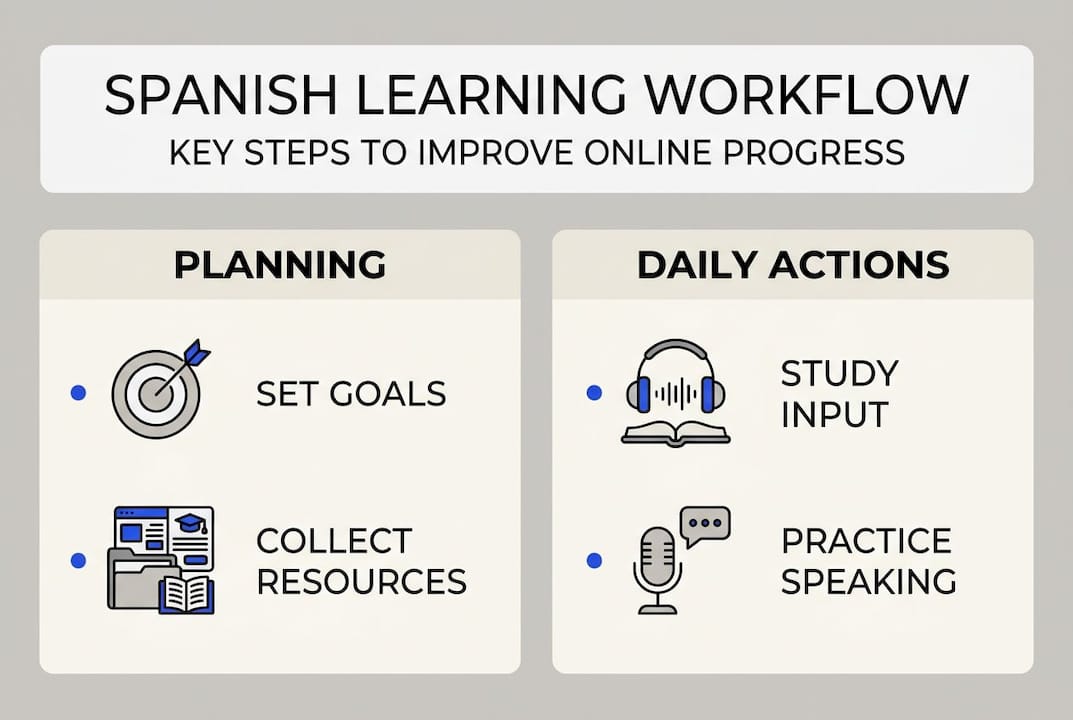
Once your goals and resources are in place, it’s time to map out an actionable daily workflow. The most effective learners do not just study randomly. They follow a deliberate ratio of activities.

A 70/20/10 split works well: 70% of your time on input (listening and reading), 20% on output (speaking and writing), and 10% on structured review. Consistency beats intensity every single time.
Here is a practical daily routine you can follow:
- Daily input (15–20 min): Listen to a Spanish podcast or watch a short video. Focus on comprehensible input, meaning content that is just slightly above your current level so you understand most of it but still encounter new language.
- Output practice (10–15 min): Speak out loud, even to yourself. Summarize what you just heard in Spanish or write three sentences about your day.
- Vocabulary review (5–10 min): Open your spaced repetition app and complete your daily deck. Spaced repetition and comprehensible input consistently outperform passive study methods.
- Weekly speaking session: Book at least one live session with a tutor or conversation partner. This is non-negotiable for building real fluency.
Here is how apps and online tutors compare:
| Feature | Apps | Online Tutors |
|---|---|---|
| Habit building | Excellent | Moderate |
| Free speaking practice | Limited | Excellent |
| Personalized feedback | None | High |
| Flexibility | Very high | Moderate |
| Cost | Low | Medium to high |
Explore speaking activities that fit naturally into your weekly schedule to keep output sessions fresh.
Pro Tip: Micro-sessions of 15 to 30 minutes count. On busy weeks, stack two or three short sessions instead of skipping entirely. Three 20-minute blocks beat one 60-minute session you never get to.
Maximize output: productive speaking and smart feedback
An effective workflow is not complete without targeted speaking and feedback methods for active skill building. Input alone builds passive understanding. Output is what turns that understanding into real communication.
Why does this matter so much? Because speaking forces your brain to retrieve and produce language under pressure, which is exactly the condition you will face in a real conversation. Without regular output, you build a large passive vocabulary you cannot actually use when it counts.
Here are practical ways to add output to your workflow, even as a beginner:
- Self-recording: Record yourself speaking for 60 seconds on a topic, then listen back and note errors.
- Conversation exchanges: Use platforms like Tandem or HelloTalk to connect with native Spanish speakers who want to learn English.
- Tutor-led sessions: Book weekly sessions with a certified instructor who can provide structured corrections.
- Writing practice: Keep a short daily journal in Spanish. Even five sentences build output habits.
- Role-play scenarios: Practice real-world situations like ordering food, introducing yourself in a meeting, or asking for directions.
“Apps are good for habit-building but rate poorly for free speaking (61 out of 100); tutoring rated highest for real improvement (78 out of 100).” — Best Way to Learn Spanish 2026
The feedback loop is what separates learners who plateau from those who keep improving. Self-review catches obvious errors. Tutor corrections catch the subtle ones you cannot hear yourself. Peer exchanges build confidence and speed. You can find structured speaking practice ideas to add variety, and when you are ready for guided support, online Spanish courses offer built-in feedback at every stage.
Track progress and adapt your workflow
Your workflow should not be static. Regular progress checks and tweaks make it adaptive and efficient. Most learners skip this step entirely, which is why they end up stuck at the same level for months.
Here is a simple process for diagnosing and fixing stalled progress:
- Weekly self-test: Take a short vocabulary quiz or listen to a podcast and check how much you understood compared to last week.
- Monthly CEFR self-assessment: Use a free online CEFR self-test to confirm whether your skills match your target level. Track progress weekly with benchmarks like official tests and self-checks to stay on course.
- Compare hours to benchmarks: Cross-reference your logged study hours with FSI estimates for your target level.
- Adjust your input and output ratio: If speaking feels weak, shift more time to output. If vocabulary is the bottleneck, increase your spaced repetition sessions.
- Book a tutor review session: Have an instructor assess your spoken or written Spanish and give you a concrete list of priorities.
Signs you need to adjust your workflow:
- You understand content but freeze when speaking
- New vocabulary is not sticking after two weeks
- You feel bored or disengaged during sessions
- Your comprehension has not improved in a month
Busy professionals do better with short daily sessions and by varying their input sources regularly. Check a realistic Spanish learning timeline to set honest expectations, and if speed is a priority, explore strategies to learn Spanish fast without burning out.
Pro Tip: Celebrate milestones. Finishing your first A1 unit, holding a two-minute conversation, or understanding a full podcast episode are all worth acknowledging. Small wins build the motivation to keep going.
Troubleshooting: common mistakes and how to fix them
Even a great workflow breaks down with a few common mistakes. Here is how to avoid and overcome them.
The most frequent errors learners make are not about effort. They are structural. Fixing them does not require more hours. It requires smarter choices.
Common pitfalls and how to fix each one:
- Relying only on apps: Apps build habits but apps alone are insufficient for real speaking fluency. Add at least one live speaking session per week.
- Skipping output entirely: If you only consume Spanish without producing it, your speaking will lag far behind your comprehension. Commit to daily output, even if it is just one minute of self-talk.
- No accountability structure: Studying alone with no deadlines or check-ins leads to inconsistency. Join a class, find a language partner, or hire a tutor to create external accountability.
- Inconsistent routines: Studying for three hours on Saturday and nothing the rest of the week is far less effective than 30 minutes every day. Frequency matters more than session length.
- Ignoring feedback: Practicing errors repeatedly reinforces them. Build a feedback cycle into your weekly routine so mistakes get corrected before they become habits.
For a broader view of what actually works, explore effective Spanish learning tips that go beyond the basics.
Pro Tip: Schedule a weekly 15-minute feedback review with a tutor or conversation partner. Even a short debrief on your most common errors each week creates dramatic improvement over time.
Our take: What most guides miss about learning Spanish online
With the nuts and bolts of Spanish learning workflows laid out, here is a candid take based on what actually works. Most online guides treat apps and passive tools as the solution. We see them as the starting point.
Real fluency does not happen inside a gamified app. It happens the moment you produce language under pressure and receive honest feedback on it. AI tools and gamified apps are emerging for informal practice but still lack the accountability and structured progression that serious learners need.
What separates learners who reach B1 from those who stall at A2 is not the quality of their app. It is the quality of their feedback loop and their willingness to adjust based on real data. Keeping a simple log of study hours, reviewing CEFR self-checks monthly, and tweaking your input and output ratio based on actual results creates genuine learning autonomy.
One-size-fits-all routines also fall short for professionals balancing demanding careers. Your workflow needs to flex with your schedule, not break when life gets busy. Build that flexibility in from the start, and you will outlast every learner who relies on motivation alone.
Level up with guided online Spanish courses
If you are serious about moving from a scattered study routine to a structured system with real results, guided instruction makes a measurable difference. A well-designed course gives you built-in progress tracking, certified feedback at every stage, and a clear path from A1 to your target level.

At Spanish Explorer, we offer Spanish courses in Singapore designed around the same CEFR benchmarks and workflow principles covered in this guide. Whether you prefer online Spanish classes that fit around your work schedule or the focused attention of private Spanish tutors, our certified instructors provide the structured feedback that apps simply cannot replicate. Take the next step toward real fluency with a course built for your goals.
Frequently asked questions
How many hours per week should I study Spanish online for steady progress?
Aim for at least 3 to 5 hours each week, but even shorter daily sessions of 20 to 30 minutes are effective when paired with a consistent workflow and regular feedback.
What is the CEFR and why does it matter for Spanish learners?
The CEFR is a standardized scale from A1 to C2 that measures language proficiency. CEFR levels are the most reliable benchmarks for setting realistic Spanish learning goals and tracking your progress over time.
Can I become fluent just using Spanish learning apps?
Apps alone are insufficient for real fluency. They build daily habits effectively, but active speaking practice and regular tutor feedback are essential for moving beyond intermediate level.
How do I check my Spanish level online?
Take a free CEFR self-assessment test online or compare your total logged study hours against FSI benchmarks to get an honest picture of where you stand.
Recommended
Back to all articlesStart Learning Spanish Today
Book a trial class and see how quickly you can progress with a professionally trained native-speaker teacher guiding the way.
Book a Trial Class