 Spanish
TL;DR:
- Proficiency levels in Spanish are defined by the CEFR, focusing on real communicative abilities rather than just grammar knowledge. Achieving each level involves practical skills across speaking, listening, reading, and writing, with significant distinctions between receptive and productive skills. Certified exams like DELE and SIELE measure these abilities, with DELE offering a permanent, comprehensive diploma and SIELE providing flexible, modular results suitable for various goals.
If you’ve ever looked at a Spanish course description and seen labels like “A2” or “B1” without knowing what they actually mean in practice, you’re not alone. Spanish language proficiency levels confuse most learners precisely because they look like bureaucratic codes rather than descriptions of real ability. They’re not. The Common European Framework of Reference for Languages, known as the CEFR, defines six clear levels that describe exactly what you can do with the language, not just what grammar rules you’ve memorized. Understanding these levels changes how you set goals, choose courses, and select the right certification exam for your needs.
Table of Contents
- Key takeaways
- Understanding Spanish language proficiency levels
- Major Spanish proficiency certifications
- Connecting proficiency levels to real-world goals
- Common myths and exam strategy mistakes
- My take on proficiency levels after years of working with adult learners
- Take the next step with Spanish Explorer
- FAQ
Key takeaways
| Point | Details |
|---|---|
| CEFR defines six levels | Spanish proficiency runs from A1 (beginner) to C2 (mastery), grouped into Basic, Independent, and Proficient bands. |
| Communicative ability drives leveling | Levels measure what you can do in real conversations, not how much grammar you know. |
| Two main certification paths | DELE offers a permanent diploma; SIELE is digital and modular with a 5-year validity. |
| B2 is the autonomy threshold | At B2, you communicate without needing native speakers to slow down or simplify. |
| Match your exam level to your goal | Choosing the wrong exam level wastes time and may fail to meet visa, work, or study requirements. |
Understanding Spanish language proficiency levels
The CEFR is the international standard used to describe six proficiency levels: A1, A2, B1, B2, C1, and C2. These group into three pairs: Basic (A1 and A2), Independent (B1 and B2), and Proficient (C1 and C2). Each level reflects what a learner can realistically accomplish across speaking, listening, reading, and writing, rather than which textbook chapter they’ve completed.
Here’s what each level looks like in practice:
- A1 (Beginner): You can introduce yourself, ask simple questions about familiar topics like prices and schedules, and understand very slow, clear speech. Think ordering a coffee or reading a hotel sign.
- A2 (Elementary): You handle routine exchanges such as shopping conversations or understanding short personal messages. Grammar is still simple, but you’re forming sentences independently.
- B1 (Intermediate): Travel becomes genuinely manageable. You follow the main points of news broadcasts on familiar topics, write simple connected texts, and describe experiences or opinions with basic fluency.
- B2 (Upper Intermediate): You read contemporary Spanish fiction, follow fast-paced TV shows without subtitles, and hold detailed conversations on abstract topics. This is where real independence begins.
- C1 (Advanced): You use Spanish flexibly for academic, professional, and social purposes. You understand implied meaning, produce well-structured arguments, and rarely search for words.
- C2 (Mastery): You understand virtually everything you hear or read, summarize information from multiple sources, and express yourself with precision in complex situations.
One distinction most people miss is the gap between receptive skills (reading and listening) and productive skills (speaking and writing). Learners typically understand more than they can produce, especially at early levels. This is why you can understand a Mexican soap opera at B2 but still struggle to write a formal email in Spanish.
The jump from B2 to C1 is also notoriously steep. Spanish requires roughly 600 to 750 classroom hours to reach B2 to C1 level, according to the U.S. Foreign Service Institute. The earlier transitions happen faster. Understanding this prevents the frustration of expecting C1 progress at the same pace as A2 to B1.
Pro Tip: When you assess your current Spanish level, test yourself in all four skills separately. Many adult learners discover they’re B1 in reading but only A2 in speaking. Knowing the gap tells you exactly where to focus your study time.
Major Spanish proficiency certifications
Two certifications dominate the Spanish language assessment space: DELE and SIELE. Both align with the CEFR, but they serve different purposes and learner profiles.
DELE vs. SIELE: what each offers
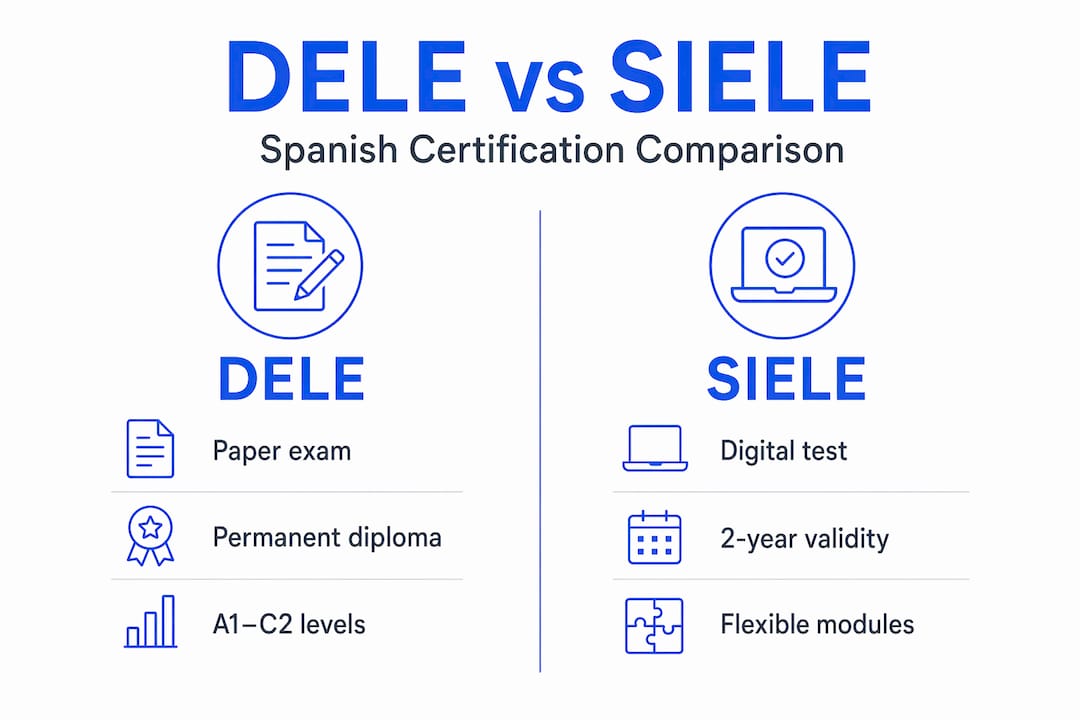
| Feature | DELE | SIELE |
|---|---|---|
| Administered by | Instituto Cervantes | UNAM, Universidad de Salamanca, Universitat de Barcelona |
| CEFR levels covered | A1 through C2 | A1 through C1 |
| Format | Paper-based | Computer-based |
| Scoring | Pass/Fail per component | Points scale up to 1000 |
| Validity | Permanent | 5 years |
| Results timeline | Approximately 3 months | Approximately 3 weeks |
| Modular options | No, must complete all components | Yes, individual skills testable |
DELE exams cover reading, listening, writing, and speaking as separate components. You must pass every component to earn the diploma. The permanent validity is a significant advantage for anyone submitting credentials for immigration, academic admission, or employment, where proof of Spanish proficiency may be required years later.
SIELE takes a different approach. It’s fully digital, provides results in roughly three weeks, and allows you to test individual skills if you only need proof in specific areas. The point-based scoring (up to 1000) also gives universities and employers a more nuanced picture of your ability than a binary pass or fail. For learn learners balancing work and personal schedules, SIELE’s modular format is a practical advantage.
Choosing between them depends entirely on your goal. If you need a credential for European immigration or for a Spanish university application, DELE is typically the recognized standard. If you want a quicker certification to support a job application or simply want to validate your level before committing to a full exam, SIELE offers flexibility.
Pro Tip: Before registering for any exam, check exactly which certification your target institution or employer accepts. Some universities specify DELE at a minimum B2 level; others accept SIELE. Spending time preparing for the wrong exam is a real risk.
Connecting proficiency levels to real-world goals
Understanding what the levels mean is one thing. Knowing which level you actually need is where most adult learners get stuck.
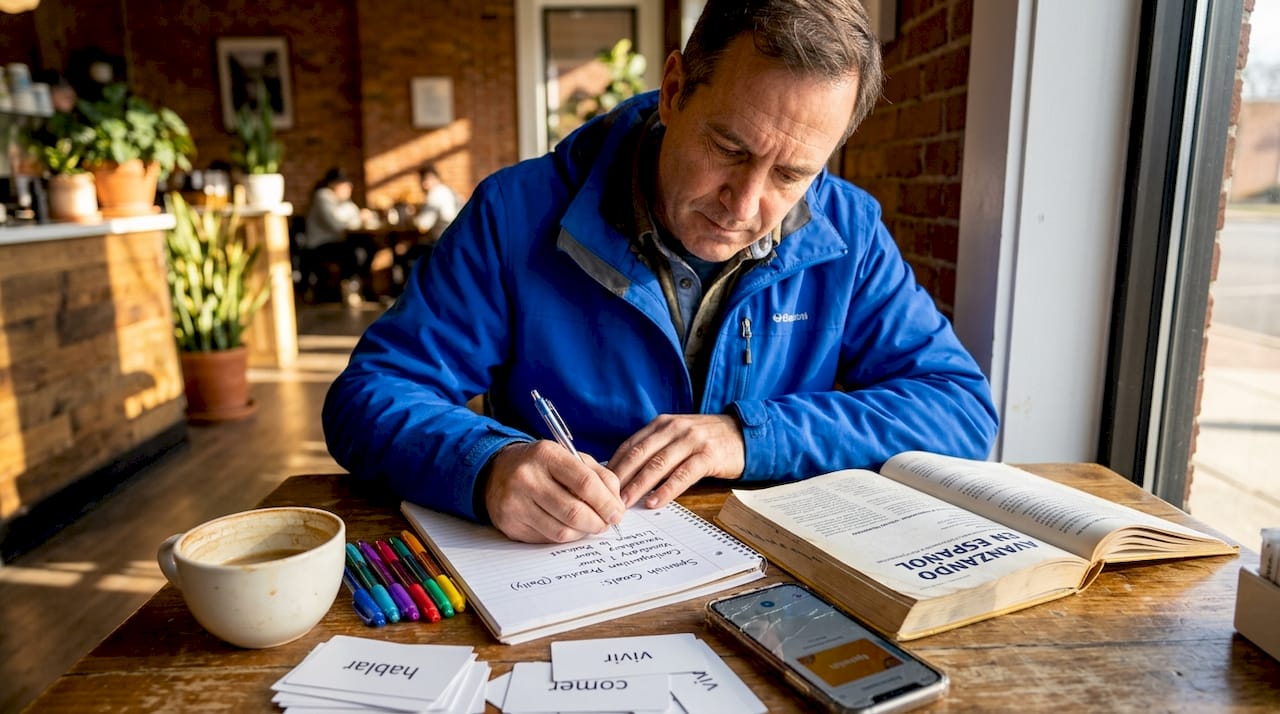
For travel and casual social interaction, B1 is a meaningful target. You can handle unexpected situations, discuss your interests, and manage most travel logistics without reverting to English. Many learners pursuing conversational Spanish find B1 genuinely satisfying for everyday use.
For professional contexts, the picture shifts. B2 is widely considered the threshold for autonomous communication where native speakers no longer need to adjust their pace or vocabulary for you. If you need to represent your company in a Spanish-speaking market, conduct meetings, or write reports, B2 is the realistic minimum. C1 becomes relevant for roles requiring Spanish as the primary working language.
Academic and immigration requirements vary. Many Spanish universities require a minimum of B2 for admission to undergraduate programs taught in Spanish. Some European residence permit processes require A2 or B1. Checking the exact institutional requirement before you begin studying saves months of misdirected effort.
Here’s a practical breakdown of target levels by goal:
- Casual travel and tourism: A2 to B1
- Conversational confidence with native speakers: B1 to B2
- Business Spanish for international meetings: B2 to C1
- Academic studies in a Spanish-speaking country: B2 minimum, often C1
- Immigration processes (country-dependent): A2 to B1 for most applications
- Working primarily in Spanish: C1
Mapping your goals to official level requirements before you start studying is one of the highest-value things you can do as an adult learner. It prevents you from investing six months into reaching B1 when your visa application requires B2.
Common myths and exam strategy mistakes
A persistent myth in language learning is that grammar mastery defines your level. It doesn’t. The CEFR prioritizes functional, communicative use of the language. You could conjugate every irregular verb correctly and still test at A2 if you can’t hold a real conversation or write a coherent paragraph.
Here are the most common mistakes adult learners make around proficiency levels and exams:
- Assuming comprehension equals production. Understanding a Spanish podcast at B2 does not mean you can speak or write at B2. Certifications assess writing and speaking directly, and many learners find these harder than expected.
- Choosing an exam level too low. Taking a DELE B1 when your job application requires B2 means repeating the entire process. Always work backward from the requirement.
- Choosing an exam level too high without preparation. Attempting C1 without structured preparation wastes registration fees and exam time. Aligning exam level to actual ability is as important as the preparation itself.
- Ignoring modular options. If your speaking is strong but your writing is weak, SIELE’s skill-specific testing lets you build up systematically rather than failing a full exam due to one weaker skill.
- Skipping the course syllabus check. Not all Spanish courses are aligned to the same CEFR benchmarks. Reviewing the course syllabus and exam structure before enrolling confirms you’re building toward the right target.
Pro Tip: If you’re preparing for DELE, practice all four skills from the very first week of preparation. Most learners overweight reading and listening practice because it feels more comfortable. Speaking and writing under timed exam conditions feel very different to studying them casually.
My take on proficiency levels after years of working with adult learners
I’ve guided hundreds of adult learners through the process of understanding where they stand in Spanish and where they need to go. The single most consistent pattern I see? People vastly underestimate the gap between passive and active skill.
I’ve worked with professionals who could read Spanish business reports at B2 but froze the moment they had to speak in a client meeting. Their reading comprehension was genuinely impressive. Their speaking confidence was closer to A2. That gap isn’t just frustrating. It costs real opportunities.
What I’ve found actually works is shifting focus to speaking and writing practice far earlier than feels comfortable. Most learners want to feel “ready” before they produce language actively. But communicative competence grows through output, not just input. The CEFR framework was built on this principle, and in my experience, it holds up completely.
For busy adult learners in Singapore, the combination of structured online Zoom classes and targeted exam preparation makes the most sense. You can progress through proficiency levels at your own pace without sacrificing consistency. And when it comes to choosing the right exam level, the conversation I have with every student is simple: what do you actually need this certification to do? That answer determines everything else.
— Paul
Take the next step with Spanish Explorer

Spanish Explorer offers adult Spanish courses tailored to every proficiency level, from beginner conversational classes to business Spanish programs and corporate group training. Whether you’re preparing for a DELE certification or building practical fluency for work, every course is taught by certified instructors fluent in both Spanish and English. Flexible online Zoom classes mean you can progress without disrupting a full work schedule. For learners who want personalized guidance, private Spanish lessons are structured around your specific goals and current level. The school is located at 10 Anson Road, Level 22, International Plaza, Singapore 079903, right above Tanjong Pagar MRT. Explore all adult Spanish courses or get in touch for a personalized recommendation.
FAQ
What are the Spanish language proficiency levels?
Spanish language proficiency levels follow the CEFR framework, which defines six levels: A1, A2, B1, B2, C1, and C2. These range from complete beginner (A1) to near-native mastery (C2), and each level describes what a learner can communicate across speaking, listening, reading, and writing.
What is the difference between DELE and SIELE?
DELE is a permanent paper-based diploma covering A1 to C2, administered by Instituto Cervantes. SIELE is a digital, point-scored exam valid for five years that covers up to C1 and allows modular testing of individual skills.
How long does it take to reach B2 in Spanish?
The U.S. Foreign Service Institute estimates roughly 600 to 750 classroom hours to reach B2 to C1 level in Spanish. The actual timeline depends on your starting point, study intensity, and how much you practice active speaking and writing.
What level of Spanish do I need for business?
B2 is the practical minimum for professional communication in Spanish without requiring native speakers to slow down or simplify. For roles where Spanish is the primary working language, C1 is a more realistic target.
Can I take a Spanish certification exam for just one skill?
Yes. SIELE allows learners to test individual skills such as speaking or writing separately, which is useful if you need to demonstrate proficiency in a specific area or want to address a weaker skill before attempting a full-format exam.
Recommended
- Spanish fluency explained: Levels, goals, and your path forward
- Spanish Teachers – Spanish Language School
- Learn Spanish Timeline: A Realistic Guide for Singapore Learners
- Latin American Spanish or Spain Spanish: A Learner’s Guide
Start Learning Spanish Today
Book a trial class and see how quickly you can progress with a professionally trained native-speaker teacher guiding the way.
Book a Trial Class