


TL;DR:
- A well-structured syllabus guides learners through CEFR levels and DELE exam preparation.
- Choosing the correct starting level prevents gaps and ensures steady progress toward fluency.
- Practice outside the classroom and consistent exposure are essential to fast language acquisition.
Picking a Spanish course without reading the syllabus is like booking a flight without checking the destination. Many learners in Singapore sign up based on price or schedule alone, then discover midway through that the course doesn’t match their goals. Whether you’re aiming for conversational confidence, a DELE certification, or Spanish fluency for a regional role, the syllabus is the real roadmap. This guide breaks down how Spanish course syllabi are structured in Singapore, what the CEFR and DELE frameworks mean for you, how long each level takes, and what you’ll actually study week by week.
Table of Contents
- Understanding the Spanish course syllabus in Singapore
- Language proficiency levels: How progress is structured
- Inside a Spanish course: Typical modules and topics
- Exams, placement, and advancing: How it all comes together
- What most course guides miss about Spanish syllabi in Singapore
- Find a Spanish course syllabus that fits your goals
- Frequently asked questions
Key Takeaways
| Point | Details |
|---|---|
| Framework-driven structure | Most Spanish courses in Singapore use CEFR and DELE frameworks to organize learning from beginner to advanced. |
| Benchmark assessments matter | Placement tests and official exams help match you with the right skill level and track real progress. |
| Practical topics dominate | Syllabi focus on real-life Spanish for work, travel, and cultural understanding. |
| Syllabus fit is crucial | Choosing a course with a recognized syllabus ensures smooth progression and exam readiness. |
Understanding the Spanish course syllabus in Singapore
A syllabus is more than a list of vocabulary words. It’s the blueprint that defines what you’ll learn, in what order, and to what standard. In the context of Spanish language education in Singapore, a well-designed syllabus tells you which grammar structures are introduced at each stage, what communicative tasks you’ll be expected to perform, and how your progress will be measured.
The most widely used framework is the CEFR, or Common European Framework of Reference for Languages. It runs from A1 (complete beginner) to C2 (mastery level), giving learners and institutions a shared language for describing proficiency. Alongside CEFR, the DELE (Diplomas de Español como Lengua Extranjera) exam system provides official, internationally recognized certification at each level. Spanish courses in Singapore for individuals, students, and professionals primarily follow the CEFR framework and DELE syllabus, making these two frameworks the backbone of structured learning here.
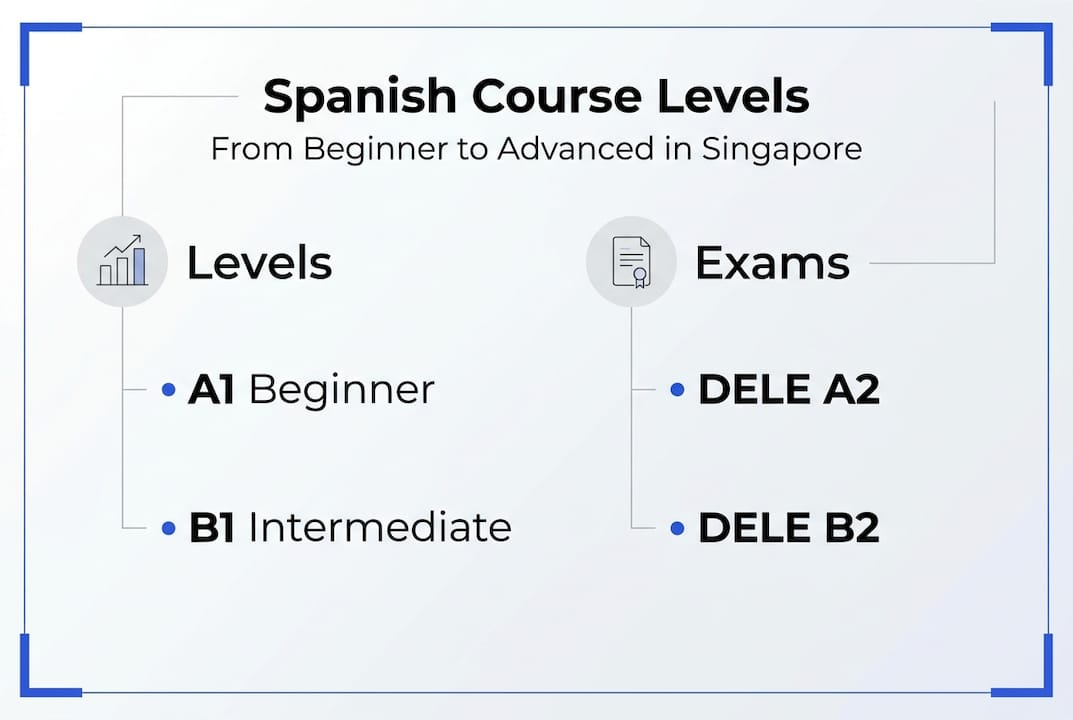
Most reputable schools blend both frameworks. CEFR defines the learning outcomes, while the DELE syllabus explained maps those outcomes to testable skills. This combination ensures that what you learn in class actually prepares you for real-world use and formal certification.
Here’s a snapshot of the common topic areas covered across a typical Spanish course syllabus:
- Beginner (A1–A2): Self-introductions, greetings, numbers, daily routines, shopping, and basic travel phrases
- Intermediate (B1–B2): Work and professional contexts, opinions, current events, travel planning, and cultural discussions
- Advanced (C1–C2): Abstract topics, academic writing, nuanced debate, literature, and professional presentations
The table below shows how these topics map to learner types:
| Learner type | Recommended starting level | Typical syllabus focus |
|---|---|---|
| Student (no experience) | A1 | Everyday vocabulary, grammar basics |
| Professional (some exposure) | A2–B1 | Workplace communication, formal writing |
| Hobbyist (travel interest) | A1–A2 | Travel phrases, cultural context |
| Corporate team | B1–B2 | Business Spanish, presentations |
Pro Tip: Always ask your school whether its syllabus is explicitly aligned to CEFR levels and DELE exam criteria. If it isn’t, you may find yourself unable to sit for certification exams or transfer credits to another institution later.
Language proficiency levels: How progress is structured
Once you know how the syllabus is usually framed, it’s crucial to see how progress is mapped from the first phrase to professional fluency.
The CEFR scale gives every learner a clear picture of what they can do at each stage. Here’s a practical breakdown:
- A1: Introduce yourself, ask simple questions, understand slow, clear speech
- A2: Handle routine transactions, describe your background, communicate in simple terms
- B1: Discuss familiar topics, write simple connected text, manage most travel situations
- B2: Interact fluently with native speakers, produce clear detailed text, understand complex arguments
- C1: Express ideas spontaneously, use language flexibly for academic and professional purposes
- C2: Understand virtually everything, summarize information from different sources with precision
Time commitment is a reality check many learners skip. A1 requires 60–80 hours of guided study, while reaching B1 demands roughly 350–400 hours. That’s a significant investment, and it’s why choosing the right starting level matters so much.
Most learners in Singapore studying 3–5 hours per week can reach A2 conversational level in about 6–9 months. DELE A2, B1, and B2 are the levels most tied to practical study and work goals, making them the most popular targets for professionals and students alike.
Here’s a comparison of CEFR and DELE to clarify how they work together:
| Feature | CEFR | DELE |
|---|---|---|
| Purpose | Defines proficiency levels | Certifies proficiency officially |
| Issued by | Council of Europe | Instituto Cervantes |
| Format | Framework (no exam) | Formal written and oral exam |
| Validity | Guides course design | Recognized globally, lifetime valid |
| Skills tested | All four skills (framework) | Reading, listening, writing, speaking |
Choosing the right starting level is a step most learners underestimate. Follow this sequence:
- Take a formal placement test with your course provider
- Review the syllabus topics for the recommended level to confirm the fit
- Consult with a certified instructor if you’re unsure between two levels
- Resist the urge to skip levels to save time—gaps in foundation skills slow you down later
- Set a target exam level (DELE A2, B1, B2) based on your personal or professional goal
Explore the full Spanish course levels available in Singapore to match your timeline and objectives.
Inside a Spanish course: Typical modules and topics
Knowing your level is just the start. The real value is in what you’ll learn in each module and how it fits your real-life aims.
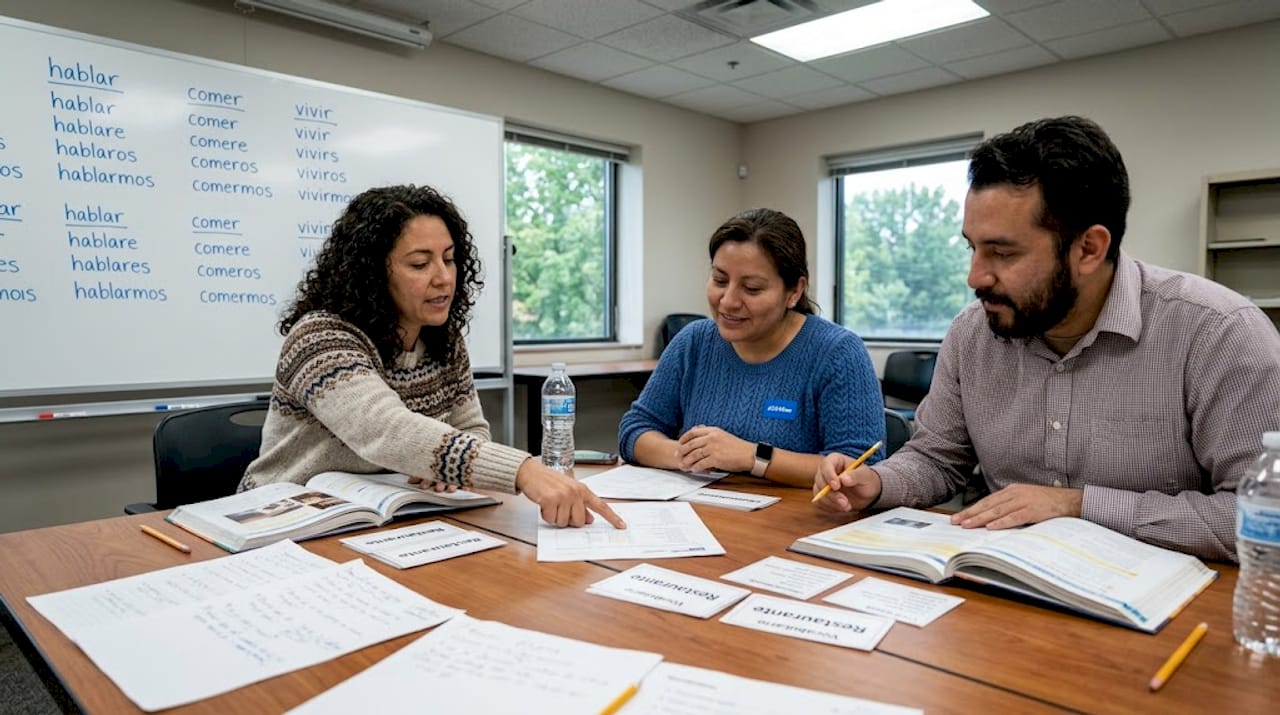
Every solid Spanish course syllabus is built around four core language skills: reading, listening, writing, and speaking. These aren’t treated equally at every level. At A1, speaking and listening dominate because you need to build sound and rhythm before tackling complex grammar on paper. By B2, writing and reading take on greater weight as you handle professional correspondence and nuanced texts.
Here’s what typical module topics look like across the learning journey:
- A1: Greetings, numbers, colors, family vocabulary, present tense verbs
- A2: Shopping dialogues, directions, past tense, describing experiences
- B1: Work emails, travel scenarios, expressing opinions, subjunctive mood introduction
- B2: Formal presentations, debate structures, complex grammar, regional accents
- C1–C2: Academic writing, literary analysis, idiomatic expressions, professional negotiation
For learners with career goals, modules at B1 and above often include business Spanish topics: writing formal reports, conducting meetings, and navigating workplace hierarchies in Spanish-speaking cultures. These aren’t extras. They’re built into the syllabus because real-world communication is the point.
Skill weighting in DELE exams (Instituto Cervantes): At A1 through B2, reading accounts for 25–35% of the exam, listening 25–35%, writing 30–40%, and oral expression 20–25%. This weighting directly influences how course syllabi allocate class time.
Practical activities like role plays, group discussions, and scenario-based tasks make up a large part of well-designed courses. You can see examples of practical Spanish activities that reinforce classroom learning in real contexts.
Pro Tip: If you have a specific weak spot, such as listening comprehension or written grammar, look for courses with a modular structure. Some programs let you focus on targeted skills, which is especially useful for professionals who already speak conversational Spanish but need to sharpen formal writing. A SkillsFuture-accredited syllabus may also qualify for funding support in Singapore.
Exams, placement, and advancing: How it all comes together
Piecing syllabus content and progression together, assessment becomes the bridge that lets you move ahead with confidence.
For learners with academic or professional goals, official exams are not optional. DELE is the gold standard for Spanish certification globally. It’s issued by the Instituto Cervantes, recognized by universities, employers, and immigration authorities worldwide, and it never expires. An alternative worth knowing is SIELE (Servicio Internacional de Evaluación de la Lengua Española), a digital exam accepted in Latin American academic and business contexts. See a detailed DELE vs SIELE compared breakdown to decide which suits your goals.
Before any of that, placement matters. Skipping levels without assessment is one of the most common and costly mistakes learners make. Arriving at B1 without a solid A2 foundation means gaps in grammar and vocabulary that compound over time, making advanced content harder to absorb.
Here’s the recommended sequence for any new learner:
- Start by contacting your school and requesting a placement test
- Get assessed through a written and spoken evaluation
- Follow the recommended level even if it feels slower than expected
- Study consistently using the syllabus as your weekly guide
- Register for the DELE exam at your target level once your instructor confirms readiness
One important statistic to keep in mind: passing a DELE exam requires a minimum of 60% overall and at least 30% in each individual skill area. This means you can’t compensate for a weak writing score with a strong oral performance. Every skill must meet the threshold, which is exactly why a balanced syllabus matters from day one.
What most course guides miss about Spanish syllabi in Singapore
Most articles about Spanish courses focus heavily on frameworks and level charts. Those are useful, but they miss something important. The learners who progress fastest are not necessarily the ones who follow the syllabus most rigidly. They’re the ones who treat the syllabus as a launchpad, not a ceiling.
In our experience at Spanish Explorer, students who plateau often do so not because the syllabus is wrong for them, but because they stop using Spanish outside the classroom. A syllabus built around DELE standards will give you the structure. What it can’t give you is the habit of thinking in Spanish, which only comes from daily exposure.
The smartest approach is to align your syllabus choice with your actual life. If you’re learning Spanish for a regional sales role, prioritize B1–B2 business modules. If you’re learning for travel, A2 with strong oral practice may serve you better than rushing to B1. And if you want to build lasting fluency, supplement your course with consistent improving Spanish fluency strategies outside of class. The syllabus opens the door. You have to walk through it.
Find a Spanish course syllabus that fits your goals
If the syllabus really is the roadmap, then choosing the right school means choosing the right map for your journey.

At Spanish Explorer, our Spanish courses in Singapore are structured around CEFR levels and DELE exam preparation, with clear learning outcomes at every stage. Whether you prefer group classes, private instruction, or the flexibility of online Spanish classes, our certified instructors design each lesson to build real-world communication skills. If you have an exam goal in mind, our DELE exam preparation programs give you targeted practice across all four tested skills. Start with a placement consultation and let the syllabus guide you toward the level, the exam, and the fluency you’re actually aiming for.
Frequently asked questions
What topics are typically covered in a Spanish course syllabus?
A Spanish course syllabus usually covers everyday topics like greetings, daily routines, travel, business communication, and cultural discussions, building all four core skills. Spanish syllabi are designed around practical language use at every level.
How do I know what Spanish level I should start at?
Take a placement test or consult your course provider before enrolling. Skipping levels without proper assessment can create gaps in your foundation that slow progress significantly.
What is the difference between CEFR and DELE in Spanish courses?
CEFR is a framework that defines proficiency levels from A1 to C2, while DELE is an official exam that certifies your proficiency at those levels. CEFR outlines levels; DELE tests and certifies them for academic and professional recognition.
How long does it take to reach a conversational level in Spanish?
With 3–5 hours of study per week, most learners reach A2 conversational level within 6–9 months. Consistency and practice outside class significantly affect how quickly you progress.
Are online Spanish courses as effective as in-person classes?
Online Spanish courses offer strong flexibility for busy professionals, but they typically provide less immersive language exposure than in-person classes. The best option depends on your schedule, learning style, and how much you supplement with real-world Spanish practice.
Sorry, the comment form is closed at this time.