 Spanish
TL;DR:
- Companies that invest in language learning see improved employee retention and better cross-cultural communication. Such programs directly enhance workforce performance, market access, and international relationships, creating competitive advantages. Tailored, flexible training that focuses on real business needs yields measurable returns and long-term growth.
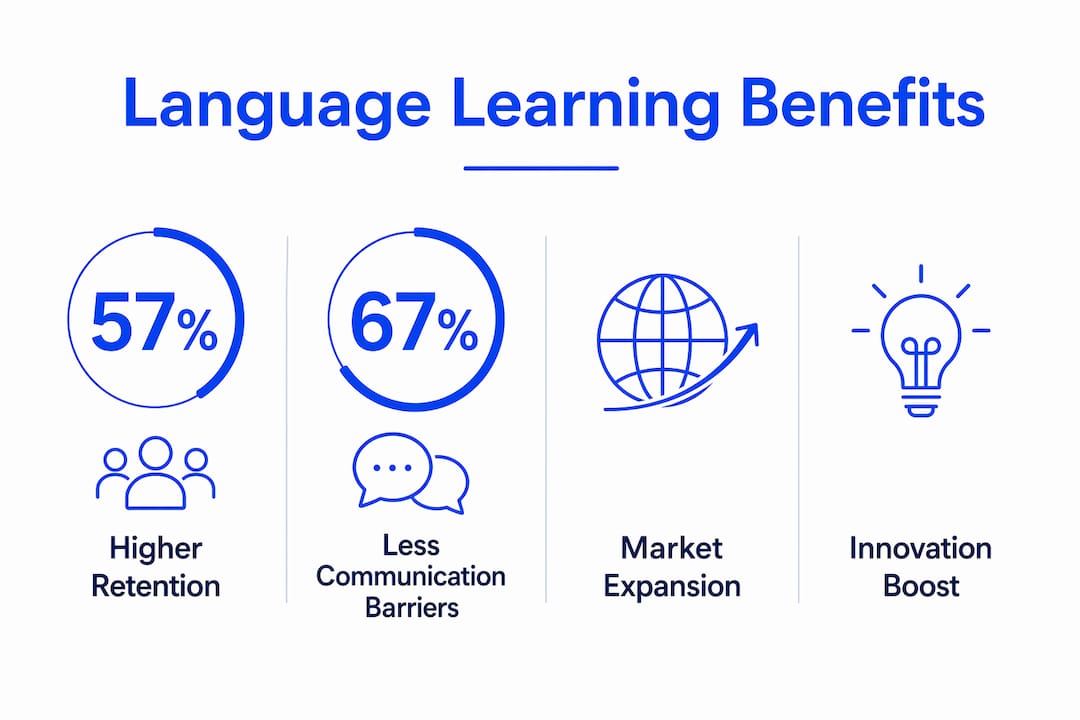
Corporate investment in language learning is defined as the deliberate allocation of budget and time toward developing employees’ foreign language skills for business purposes. Companies that prioritize this investment gain measurable advantages: stronger cross-cultural relationships, fewer communication breakdowns, and a workforce that can operate confidently in international markets. Research shows that employees who receive language training are up to 57% more likely to stay with their company. That single statistic reframes language programs from a soft benefit into a hard retention tool. Understanding why companies invest in language learning, and how to do it well, gives HR leaders and business decision-makers a direct path to workforce performance gains.
Why companies invest in language learning: the core business case
The business case for corporate language investments rests on three pillars: retention, communication efficiency, and market access. Each one connects directly to revenue and competitive position. When employees can communicate clearly across languages, projects move faster, client relationships deepen, and internal teams collaborate with less friction.

The advantages of corporate language programs extend beyond individual skill development. Language training signals to employees that the company values their growth. That signal matters: workers who feel invested in are more engaged, more productive, and less likely to leave. The cost of replacing a single employee typically exceeds the annual cost of a well-run language program, which makes the ROI calculation straightforward.
Multilingualism also functions as a measurable macroeconomic advantage, supporting international cooperation and knowledge transfer in globalized markets. For companies operating across Asia, Latin America, or Europe, this is not abstract. It shows up in contract negotiations, partnership meetings, and client onboarding calls where language fluency determines whether trust is built or lost.
How language skills improve employee performance and engagement
Language training produces direct, observable changes in how employees perform at work. The most immediate effect is communication clarity. Employees who can express ideas precisely in a second language make fewer errors in written reports, client emails, and cross-border project briefs.
Fluent language skills boost participation in meetings and international projects, improving professionalism and employee confidence. This matters because hesitation in cross-cultural settings often signals a language gap, not a knowledge gap. When employees gain language confidence, they contribute more actively, which raises the quality of decisions made in those rooms.
The engagement link is equally strong. Employees who see language development as part of their career path at a company feel more connected to that company’s future. The impact of bilingual employees reaches beyond individual performance. It creates internal networks where knowledge moves more freely across departments and geographies.
Key performance benefits of language training include:
- Fewer miscommunications in cross-border project teams
- Higher confidence in client-facing and negotiation roles
- Greater willingness to take on international assignments
- Stronger peer relationships across multilingual teams
- Improved written communication quality in business correspondence
Pro Tip: Link language training directly to performance reviews and promotion criteria. Employees engage more seriously with programs when language skills connect to career advancement, not just personal enrichment.
Why cultural competence matters for global business success
Language skills and cultural competence are inseparable. Learning a language forces you to understand how another culture thinks, prioritizes, and communicates. That understanding prevents the kind of costly misreads that derail partnerships and client relationships.
Language learning fosters empathy and intercultural understanding needed for sensitive communications that AI cannot replace. This is the core limitation of relying on translation technology alone. AI tools handle vocabulary and grammar. They do not handle tone, implication, or the cultural weight behind a phrase.
“AI translation tools aid logistics and early contact but lack the intercultural and emotional nuance supplied by human language skills. The depth of relationship that sustains long-term business partnerships requires human communication, not machine output.”
The practical consequences of poor cultural competence are concrete. A proposal delivered in the wrong register for a Latin American client signals disrespect, even if the words are technically correct. A negotiation that ignores hierarchy norms in a Spanish-speaking market can collapse a deal that looked certain on paper. Language training addresses these risks directly.
Steps companies take to build cultural competence through language programs:
- Pair language instruction with cultural context modules covering business etiquette and communication norms.
- Use cultural immersion experiences to deepen understanding beyond classroom vocabulary.
- Assign language-trained employees as cultural liaisons on international projects.
- Encourage employees to practice with native speakers, not just instructors.
- Measure cultural competence alongside language proficiency in program evaluations.
Measurable business impacts: productivity, market expansion, and innovation
The business impacts of language investment show up in three areas: operational efficiency, market reach, and the capacity to generate new ideas across diverse teams.
On the operational side, 67% of executives report that communication barriers negatively affect team performance. That figure represents lost hours, repeated meetings, delayed decisions, and errors that require correction. Language training reduces all of these costs by giving teams a shared communication foundation.
Market expansion is the most direct revenue argument for language investment. A sales team that speaks Spanish can engage clients across 20 countries in Latin America and Spain without relying on intermediaries. That access compresses the sales cycle and builds the kind of direct trust that intermediaries cannot replicate. For Singapore-based companies targeting Spanish-speaking markets, this is a concrete competitive advantage.
| Business Impact Area | Effect of Language Training |
|---|---|
| Employee retention | Up to 57% higher likelihood of staying with the company |
| Team performance | Reduces negative impact from communication barriers |
| Market access | Direct engagement with Spanish-speaking markets across 20+ countries |
| Innovation capacity | Diverse multilingual teams generate broader idea pools |
| Client trust | Native-language communication builds deeper relationships |
Innovation is the least obvious but equally real benefit. Multilingual competence improves cognitive flexibility and participation in transnational professional networks. Teams that think across languages also think across frameworks. They bring different problem-solving approaches to product development, client strategy, and operational challenges.
Pro Tip: Track language program ROI by measuring specific business outcomes before and after training: meeting participation rates, error rates in cross-border communications, and time-to-close on international deals. Concrete metrics make the investment case undeniable to leadership.
How to implement effective corporate language programs
Effective corporate language programs share one defining characteristic: they are built around the actual communication needs of the employees in them, not around a generic curriculum. A sales director preparing for Latin American client meetings needs different training than a logistics coordinator managing Spanish-speaking suppliers.
The most successful programs use a mixed delivery model. Online, flexible language courses accommodate hybrid and remote work schedules, which is the reality for most professional teams in 2026. In-person or live online sessions with certified instructors add the interactive practice that self-paced apps cannot provide. The combination produces faster progress and better retention of skills.
Best practices for building a language program that delivers results:
- Conduct a needs assessment before selecting a program. Identify which languages, skill levels, and communication contexts matter most for each team.
- Set clear learning objectives tied to business goals, not just proficiency levels.
- Use multilingual instructors who understand both the target language and the professional context of your industry.
- Build in regular progress checkpoints with personalized feedback, not just end-of-course assessments.
- Create accountability structures: team-based learning goals, manager check-ins, and visible recognition for progress.
Tailored corporate language training aligned with company objectives drives better engagement and faster return on training investment. Generic programs produce generic results. The more precisely a program maps to real work scenarios, the faster employees apply what they learn.
Key Takeaways
Corporate language investment delivers measurable returns in retention, performance, and market access when programs are tailored to real business communication needs.
| Point | Details |
|---|---|
| Retention impact | Language training makes employees up to 57% more likely to stay with their company. |
| Communication efficiency | Reducing language barriers directly cuts errors, delays, and meeting costs in cross-border teams. |
| Cultural competence | Human language skills provide the empathy and nuance that AI translation tools cannot replicate. |
| Market expansion | Language-fluent teams access new markets directly, compressing sales cycles and building client trust. |
| Program design | Tailored, flexible programs tied to business goals produce faster ROI than generic language courses. |
Language in business is not a soft skill anymore
I have watched companies treat language training as a nice-to-have for years. The logic was always the same: “Our people speak English, and that’s enough.” That assumption is becoming expensive.
What I have seen shift in 2026 is the recognition that AI translation handles the surface layer of communication but leaves the relational layer completely exposed. A machine can translate a contract. It cannot read the room in a negotiation, pick up on a client’s hesitation, or know when to slow down and ask a clarifying question in the client’s own language. Those moments are where deals are won or lost.
The companies I find most impressive are the ones that treat language learning as a culture-building tool, not a training checkbox. When leadership visibly participates in language programs, it signals that the company takes international relationships seriously at every level. That signal travels further than any internal communication about global strategy.
The future belongs to workforces that can think and communicate across languages. The companies investing now are building that capacity before their competitors realize it matters. For HR leaders, the question is not whether to invest. The question is how quickly you can build a program that actually sticks.
— Paul
Spanish Explorer’s corporate language programs for your business
Spanish Explorer offers adult Spanish courses designed specifically for business professionals and corporate teams in Singapore. Whether your team needs conversational Spanish for client relationships or business Spanish for formal negotiations, the programs are structured to deliver practical communication skills from the first session.

Spanish courses for corporate teams are available in group, private, and online formats, making it straightforward to fit training into a busy professional schedule. Live online classes via Zoom give remote and hybrid teams full access to certified instruction without travel. Spanish Explorer’s instructors are fluent in both Spanish and English, which means employees learn in context and apply skills faster. For teams ready to build real language capability, private Spanish classes offer personalized pacing aligned with each learner’s professional goals.
FAQ
Why do companies invest in language learning?
Companies invest in language learning to improve employee retention, reduce communication errors, and access international markets more effectively. Research shows language-trained employees are up to 57% more likely to stay with their employer.
What is the ROI of corporate language training?
Language training ROI shows up in measurable outcomes including lower turnover costs, faster cross-border project completion, and direct revenue from new market access. Tailored programs aligned with business goals produce the fastest returns.
Can AI translation replace corporate language training?
AI translation handles basic logistics and early-stage contact but cannot replicate the cultural empathy and emotional nuance that human language skills provide. Deep business relationships require human communication competence.
How do language skills improve employee performance?
Language skills increase communication clarity, boost confidence in international settings, and raise participation in cross-border meetings and projects. These gains translate directly into better project outcomes and stronger client relationships.
What languages should companies prioritize for training?
The right language depends on the company’s target markets and client base. For companies engaging with Latin America, Spain, or the growing Spanish-speaking business community in Asia, Spanish is a high-priority investment for 2026 and beyond.
Recommended
Start Learning Spanish Today
Book a trial class and see how quickly you can progress with a professionally trained native-speaker teacher guiding the way.
Book a Trial Class