


TL;DR:
- Learning español opens global career, academic, cultural, and networking opportunities for Singaporeans.
- Reaching conversational fluency typically takes 3-9 months with consistent practice and exposure.
- Various courses, including group, private, online, and hybrid formats, suit different goals and schedules.
Spanish, or español, is spoken by over 500 million native speakers worldwide, making it the second most spoken native language on the planet. Many Singaporeans quietly dismiss it as a language that belongs elsewhere, too difficult, too distant, too irrelevant to daily life in this city-state. That assumption is wrong, and more importantly, it’s costing people real opportunities. Whether you’re chasing a promotion, planning extended travel through South America, or simply craving a new intellectual challenge, learning español is one of the most practical and rewarding decisions you can make right here in Singapore.
Table of Contents
- What does ‘español’ really mean for learners in Singapore?
- How long does it take to master español? Realistic expectations
- Types of Spanish courses in Singapore: Which suits you?
- Essential tips for excelling in español
- Why most Singaporeans underestimate the power of español
- Ready to start your Spanish journey in Singapore?
- Frequently asked questions
Key Takeaways
| Point | Details |
|---|---|
| Global relevance | Spanish is one of the most widely spoken languages, opening doors in business, travel, and culture. |
| Attainable fluency | With 3-5 hours of regular weekly practice, conversational proficiency is achievable in months. |
| Flexible learning options | Singapore offers diverse Spanish courses—group, private, and online—to suit every schedule and learning style. |
| Practical strategies | Active use, native teachers, and local immersion techniques are key to mastering español efficiently. |
What does ‘español’ really mean for learners in Singapore?
With the broader picture set, let’s break down what español actually means for you in Singapore.
Español is simply the Spanish language, a member of the Romance language family, which also includes French, Italian, and Portuguese. It evolved from Latin and today functions as the official language in 21 countries, spanning Europe, Latin America, and parts of Africa. That’s not a regional language. That’s a global communication system.
“Español is far more than words and grammar. It’s a passport to 21 countries, hundreds of cultures, and an economic zone that touches every major industry from tourism to technology.”
For Singaporeans specifically, the case for español is surprisingly strong. Singapore sits at the center of global trade. The country’s economy depends on international partnerships, and its workforce is expected to operate across borders. Spanish opens doors to markets in Spain, Mexico, Colombia, Argentina, Chile, and the United States’ massive Spanish-speaking community. These aren’t minor economies. Together, Spanish-speaking countries represent hundreds of billions of dollars in annual trade activity.
Here’s why learning español matters so directly for learners in Singapore:
- Career advancement: Industries like banking, shipping, tourism, and diplomacy increasingly seek professionals who can communicate with Spanish-speaking clients and partners.
- Academic opportunities: Universities in Spain and Latin America offer world-class programs, many at lower tuition than their English-language counterparts.
- Cultural competence: Understanding a language means understanding the people behind it, a skill that makes you more effective in negotiations, partnerships, and collaborations.
- Personal enrichment: From Gabriel García Márquez’s novels to Pedro Almodóvar’s films, español gives you direct access to extraordinary creative work.
- Global networking: With 500 million native speakers worldwide, every room you walk into globally has a higher chance of including a Spanish speaker.
If you’ve been considering Spanish courses in Singapore, the reasons to start are more compelling now than ever before.
How long does it take to master español? Realistic expectations
Understanding the meaning and impact of español, the natural next question is: how long does it actually take to learn it?
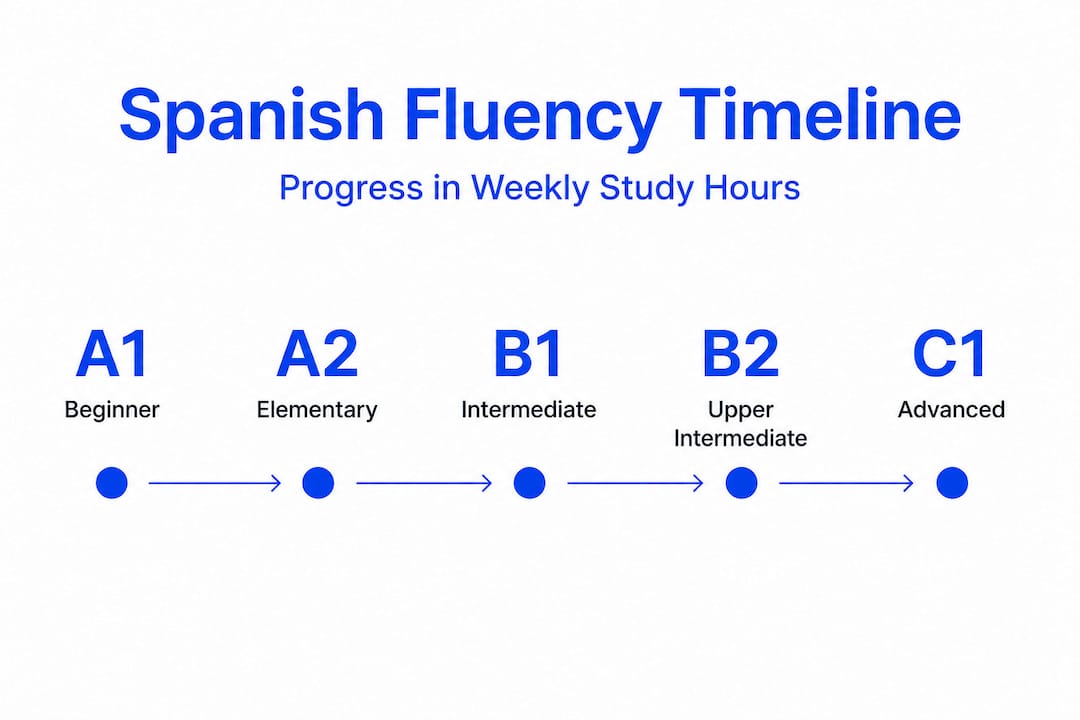
The honest answer depends on your goals, your starting point, and how consistently you practice. For most adult learners, reaching conversational fluency at the A2 level of the Common European Framework of Reference (CEFR) takes a few months of steady effort. Reaching the B1 level, where you can handle most everyday conversations comfortably, typically requires around 200 to 300 hours of practice over a longer period.
For advanced fluency at the B2 or C1 level, where you can work professionally or study in Spanish with ease, the standard benchmark is 600 to 750 hours of total study and practice. That sounds like a lot, but spread over two to three years of regular classes and self-study, it’s completely achievable.
Here’s what the research actually shows in a Singapore context:
| Proficiency level | Approximate hours needed | Realistic timeline (3-5 hrs/week) |
|---|---|---|
| A1 (Beginner) | 60 to 100 hours | 3 to 5 months |
| A2 (Elementary) | 100 to 180 hours | 6 to 9 months |
| B1 (Intermediate) | 200 to 300 hours | 12 to 18 months |
| B2 (Upper intermediate) | 400 to 600 hours | 2 to 3 years |
| C1 (Advanced) | 600 to 750 hours | 3 to 4 years |
A study using a flipped learning approach in a Singapore A2 Spanish as a Foreign Language (SFL) course produced striking results. Over just 11 weeks, students improved their DELE speaking interaction scores from a mean of 2.4 to a mean of 3.6, a statistically significant gain confirmed by the Wilcoxon test. That’s meaningful progress in under three months when the right method is applied.
Pro Tip: Three to five hours of Spanish practice per week is the sweet spot for steady, sustainable progress. If you commit to this consistently, you’ll notice real gains within the first two to three months.
The two biggest accelerators are motivation and native exposure. Learners who engage with Spanish media, music, and conversation outside the classroom progress measurably faster than those who only study during class time. If you want to learn Spanish quickly, pairing structured instruction with daily immersion habits is your best strategy.
Types of Spanish courses in Singapore: Which suits you?
Now that you know what to expect in your learning journey, let’s examine the different course formats available to maximize your progress.
Not all Spanish courses are built the same, and your best fit depends on your schedule, your budget, your personality, and your goals. Here’s a practical breakdown of the main options available in Singapore.
1. Group classes: These are the most common starting point. They’re more affordable than private lessons and create a social learning environment where peer support helps keep motivation high. Beginners often thrive in groups because hearing classmates make and correct mistakes reduces the anxiety of making your own.
2. Private classes: If you have a specific goal, a corporate presentation in Spanish, a DELE exam to prepare for, or a very tight deadline, private Spanish classes move faster. Your instructor can customize every session to your exact gaps and goals. You won’t spend time reviewing material you already know.
3. Online Spanish courses: These are ideal for professionals with unpredictable schedules. Online Spanish courses eliminate the commute entirely and let you log in from anywhere. The trade-off is that the social energy of a classroom setting is harder to replicate digitally, though good platforms compensate with live sessions and interactive tools.
4. Hybrid and flipped learning: This newer format assigns video lessons and reading for homework, then uses class time for speaking practice, problem-solving, and cultural discussions. Research from Singapore shows this approach significantly boosts speaking performance and learner motivation, though evidence on written test scores compared to traditional formats is mixed.
Here’s a side-by-side comparison to help you decide:
| Format | Best for | Cost level | Speed of progress |
|---|---|---|---|
| Group classes | Beginners, social learners | Low to moderate | Steady |
| Private classes | Goal-specific, busy professionals | Higher | Fast |
| Online classes | Flexible schedules | Low to moderate | Moderate |
| Hybrid/flipped | Motivated, self-directed learners | Moderate | Fast to very fast |
Studies comparing group vs private lessons confirm that group classes are cheaper and more motivating socially, while private classes deliver faster personalized progress. Evidence on flipped learning is broadly positive for motivation and speaking skills, even if written score improvements vary by individual.
1. Clarify your primary goal before enrolling. Are you learning for travel, work, or academic credit?
2. Assess your schedule honestly. A course you can’t attend consistently will slow you down.
3. Try a trial class before committing to a full term.
4. Ask about instructor credentials. Certified native speakers make a measurable difference.
5. Look for schools that align their curriculum with DELE standards for recognized benchmarking.
Pro Tip: If you’re unsure whether group or private lessons suit you better, many schools offer trial sessions that let you experience both formats before making a financial commitment.
Essential tips for excelling in español
You’ve chosen your course. Now let’s boost your learning outcomes with proven strategies and common-sense tips.
Structured instruction gives you the framework, but what happens between classes determines how fast you progress. Here are the habits and strategies that consistently produce results for Spanish learners in Singapore.
- Stick to a weekly schedule: Consistent 3-5 hours of practice per week yields A2 proficiency within months. Sporadic cramming doesn’t produce the same retention. Short, regular sessions outperform long, infrequent ones every time.
- Prioritize speaking early: Many learners wait until they feel “ready” to speak. That moment never comes on its own. Start speaking in simple sentences from week one. Mistakes are how your brain encodes corrections.
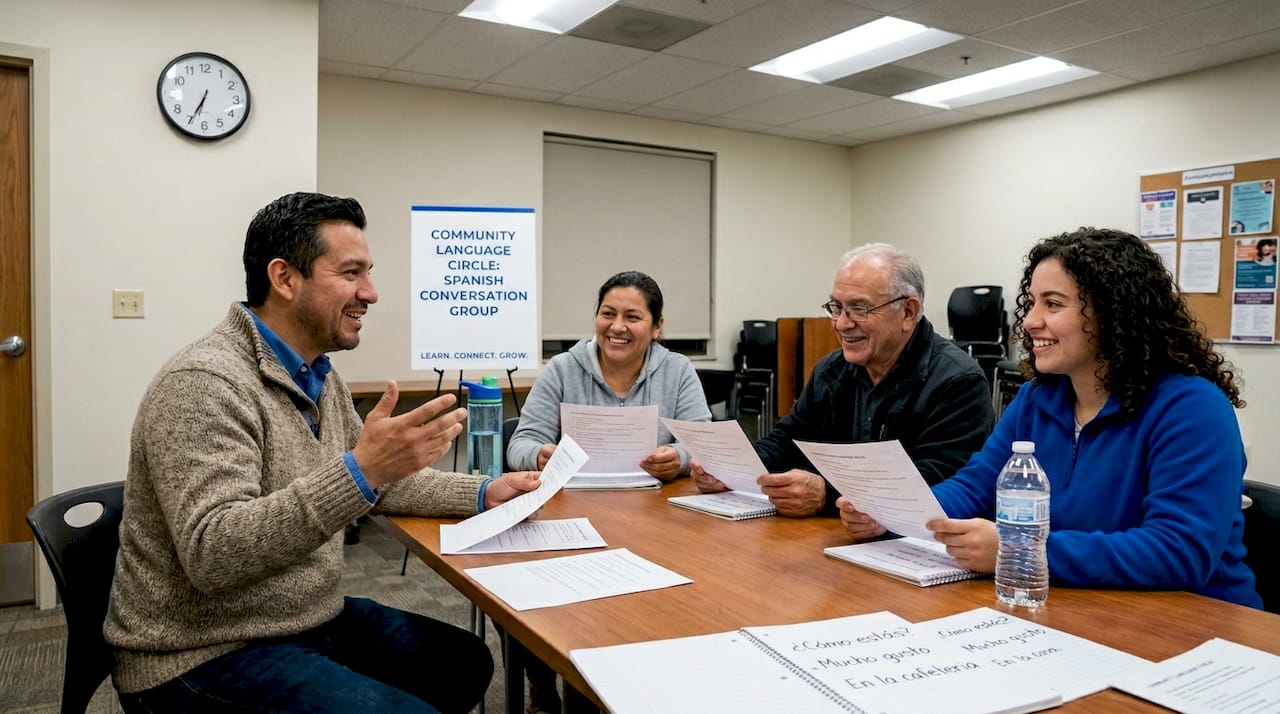
- Use Singapore’s multicultural environment: Singapore has cultural communities from across the globe. Seek out Spanish-speaking communities through meetups, embassy events, and language exchange programs. Real conversation with native speakers is irreplaceable.
- Choose native-speaking instructors: Native teachers don’t just teach grammar. They teach rhythm, intonation, cultural humor, and the casual expressions textbooks never cover. These details are what make you sound natural rather than robotic.
- Track your progress with DELE metrics: The DELE (Diplomas de Español como Lengua Extranjera) is the internationally recognized proficiency test for Spanish. Using its scoring framework as a personal benchmark keeps your goals concrete and measurable.
- Immerse with authentic media: Spanish music, podcasts, films, and YouTube channels expose you to natural speech patterns at a pace that classroom exercises can’t replicate. Start with subtitled content and gradually reduce the support you need.
For practical ideas on building your speaking confidence outside the classroom, explore these Spanish speaking practice ideas designed specifically for Singapore learners. You might also be surprised to learn just how English supports Spanish learning, since the two languages share thousands of cognates, words that look and sound similar with the same meaning.
Pro Tip: Pair every new vocabulary word with a visual or an emotion. The brain stores language more effectively when it’s connected to a sensory experience. Try watching a Spanish cooking show while cooking dinner at home.
The best way to learn Spanish in 2026 combines certified instruction with consistent real-world practice and cultural engagement. No single method works in isolation. The learners who succeed fastest treat Spanish as part of their daily life, not just a weekly class they attend.
Why most Singaporeans underestimate the power of español
There’s a persistent belief in Singapore that Spanish is a “nice to have” rather than a “need to have.” It gets lumped in with hobby skills like pottery or watercolor painting, something pleasant but peripheral to real career and life goals. That framing is wrong, and it’s quietly holding people back.
The mistake is thinking about español purely as a language skill. What you’re actually building is cultural agility. That means the ability to enter a different cultural context, read its norms, adapt your communication style, and build trust with people whose background is fundamentally different from yours. That skill is extraordinarily rare and extraordinarily valuable in a city like Singapore.
Singapore’s geographic and economic position makes this especially powerful. The country functions as a regional hub for companies operating across Asia, Europe, and the Americas. Many of those companies have operations in Spain, Mexico, Colombia, or Chile. A professional who can navigate those relationships without relying on translators or middlemen has a genuine competitive advantage, one that shows up directly in how quickly they advance.
Research confirms that Spanish skills in Singapore’s finance and tourism sectors are increasingly linked to career mobility. It’s not a coincidence. Global employers use language skills as a proxy for broader qualities: intellectual curiosity, disciplined effort, and the willingness to step outside your comfort zone. Español on your résumé signals all three simultaneously.
What most people also miss is that Singapore is an ideal place to learn Spanish. The institutional infrastructure exists, qualified schools with DELE-aligned curricula, native-speaking instructors, multicultural practice environments, and a professional community that values international competence. The barriers are lower here than almost anywhere else in Asia.
The people who invest in español now are not chasing a trend. They’re positioning themselves ahead of one. The global economy’s center of gravity continues to shift toward regions where Spanish is deeply embedded. Getting fluent before that shift fully materializes is the kind of strategic move that looks obvious in retrospect.
Ready to start your Spanish journey in Singapore?
If the case for español has landed, the next step is straightforward: find a program that matches your goals and get started.
At Spanish Explorer, we’ve designed our Spanish courses to meet learners exactly where they are, whether that’s a complete beginner with zero prior exposure or an intermediate student preparing for DELE certification. Our curriculum aligns with international DELE standards, and every class is led by certified native Spanish teachers who bring real cultural context into every session. Flexible group, private, and online formats mean you can build Spanish into your life without overhauling your schedule. The best way to see if it’s the right fit? Book a trial Spanish class and experience the approach firsthand before making any commitment.
Frequently asked questions
Is Spanish hard to learn for English speakers in Singapore?
Spanish is considered one of the more accessible languages for English speakers because of its phonetic spelling and thousands of shared cognates with English. With structured courses, Singapore-based learners have shown significant speaking score improvements in as little as 11 weeks.
How many hours do I need to reach conversational Spanish?
Most learners reach conversational Spanish at the A2 level within several months when practicing 3-5 hours weekly. The key is consistency over intensity.
What are the benefits of picking group vs. private Spanish lessons?
Group lessons are more affordable and build motivation through peer interaction, while private classes offer faster, customized progress. The best format depends entirely on your personal learning style, budget, and timeline.
Do I need to know Spanish for travel or work opportunities in Singapore?
Spanish isn’t required, but it creates meaningful advantages. Professionals with español proficiency access roles and partnerships in trade, tourism, and diplomacy that would otherwise require intermediaries, making them more valuable to global employers.
Sorry, the comment form is closed at this time.