 Spanish
TL;DR:
- Business language programs aim to improve employees’ communication skills and cultural understanding in professional settings. They focus on high-frequency vocabulary, practical tasks, and cultural norms to produce real workplace results. Effective programs integrate role-specific content, flexible delivery, and cultural modules to foster confident cross-cultural communication.
Business language programs are specialized training courses designed to build employees’ communication skills and cultural fluency in professional settings. For organizations expanding into Spanish-speaking markets, or professionals working alongside Spanish-speaking colleagues and clients, these programs deliver far more than basic vocabulary. They build the practical confidence to negotiate, present, and collaborate across cultures. This guide to business language programs covers what effective Spanish corporate language learning looks like, how to choose the right format, and how to implement training that produces real workplace results.
What are the core components of effective Spanish business language programs?
The strongest Spanish business language programs share a clear structural logic: they teach what professionals actually use, not what textbooks traditionally cover. That means prioritizing high-frequency business vocabulary over abstract grammar rules. Programs that focus on approximately 2,000 essential words cover roughly 80% of daily workplace communication. That concentration of effort produces faster, more practical results than broad fluency approaches.
Effective curriculum design for Spanish business language training includes these core elements:
- Business vocabulary by context. Industry-specific terminology for sectors like finance, logistics, healthcare, and technology gives professionals the words they need immediately on the job.
- Practical communication tasks. Writing professional emails, leading meetings, delivering presentations, and handling negotiations are the four skill areas that appear most consistently in workplace Spanish programs.
- Listening and speaking balance. Programs that weight speaking practice equally with reading and writing produce learners who can hold real conversations, not just pass written tests.
- Role plays and simulations. Scenario-based learning helps professionals apply new skills directly in workplace contexts, reducing the gap between classroom and conference room.
- Cultural modules. Business etiquette, communication styles, and relationship-building norms vary significantly across Spanish-speaking countries. Programs that ignore this leave professionals underprepared.
Pro Tip: When reviewing a Spanish business language program, ask the provider to show you a sample lesson. If the lesson centers on grammar drills rather than a realistic workplace scenario, the curriculum is not built for professional outcomes.
The CEFR framework (Common European Framework of Reference for Languages) provides a useful benchmark for measuring progress. Most business communication goals align with CEFR levels B1 through B2, where professionals can handle routine workplace interactions with confidence.
How are Spanish business language courses delivered and structured?
Delivery format determines whether a program fits into a professional’s actual schedule. The three main models each serve different organizational needs.
- Self-paced online courses. Professionals complete modules independently, on their own timeline. This format works well for individuals with unpredictable schedules but requires strong personal discipline. Without live interaction, speaking skills can lag behind reading and writing.
- Instructor-led group classes. A certified instructor leads scheduled sessions with a small cohort. This format builds speaking confidence faster because learners practice with real people under guided conditions. Spanish Explorer’s group corporate classes follow this model, with sessions led by certified instructors fluent in both Spanish and English.
- Blended learning programs. Blended approaches combine self-paced digital content with live instructor sessions. Research confirms that interactive online sessions augment retention over pure self-paced formats. This model suits organizations that need scalable delivery without sacrificing speaking practice.
Most professionals can complete a core business proficiency program in 3 to 6 months by studying 30–60 minutes daily. That time commitment is realistic for working adults when sessions are scheduled consistently. Programs that demand two-hour blocks several times a week see higher dropout rates among busy professionals.
Pro Tip: For corporate rollouts, schedule language sessions at a fixed time each week, ideally during working hours. Treating training as optional after-hours activity signals that the organization does not consider it a real priority, and participation drops accordingly.

Online delivery via platforms like Zoom has made workplace Spanish lessons accessible for teams distributed across multiple offices or working remotely. Spanish Explorer offers online private and group classes specifically designed for Singapore-based professionals who need flexibility without losing the benefit of live instruction.
How do organizations evaluate and implement business language training?
Selecting the right program requires more than reviewing a brochure. Effective vendor evaluation uses a structured scoring rubric across multiple criteria, turning subjective impressions into objective decisions. The criteria that matter most for Spanish business language training include:
- Instructor qualifications. Are instructors certified? Do they have experience teaching business Spanish specifically, not just general conversational Spanish?
- Content relevance. Does the curriculum reflect your industry’s vocabulary and communication scenarios?
- Assessment mechanisms. Does the program measure progress at regular intervals with clear benchmarks tied to CEFR levels?
- Scheduling flexibility. Can the program accommodate shift workers, remote employees, or teams across time zones?
- Reporting and accountability. Does the provider give organizations visibility into learner progress and completion rates?
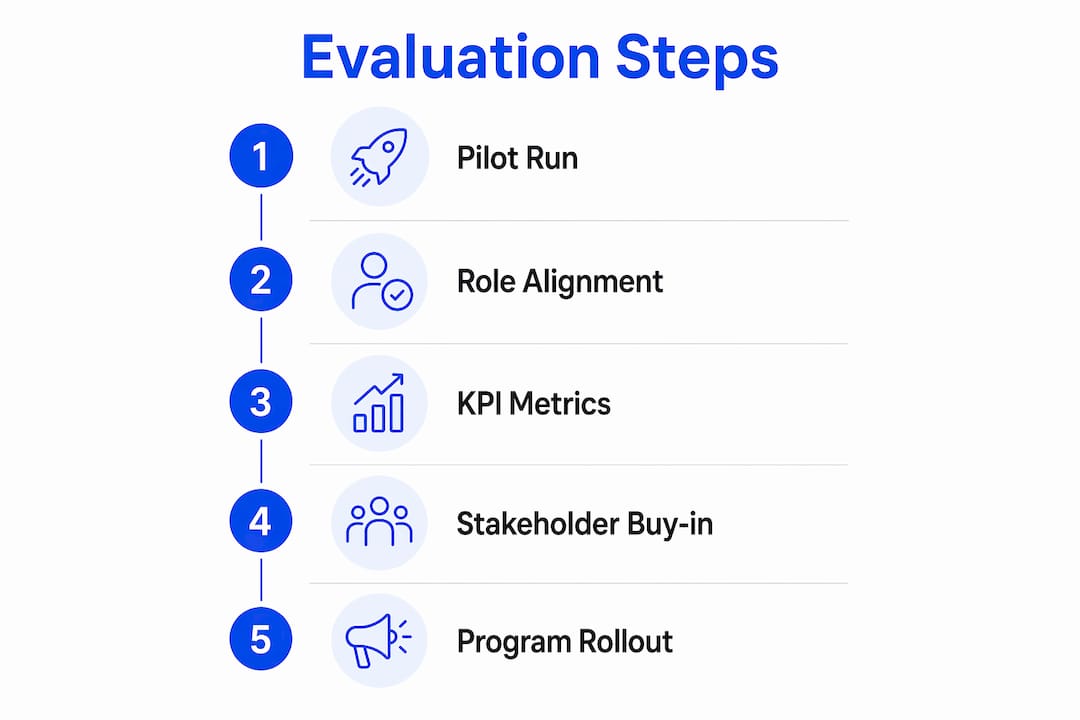
Before committing to a full rollout, run a pilot program with a small, diverse group of employees. Pilots reveal content gaps, platform usability issues, and engagement problems that do not appear in a sales demo. A pilot cohort of 8–15 employees across different roles and seniority levels gives you representative feedback.
Aligning language objectives with specific job roles is the step most organizations skip. General fluency goals rarely produce organizational ROI. A logistics coordinator needs different Spanish vocabulary than a sales manager or a finance analyst. Linking training progress to role-specific KPIs, such as the ability to conduct a supplier call in Spanish or write a client proposal, gives both learners and managers a clear measure of success.
| Evaluation criterion | What to look for |
|---|---|
| Instructor expertise | Certified instructors with business Spanish specialization |
| Curriculum design | Role-specific vocabulary and scenario-based tasks |
| Progress tracking | Regular assessments tied to CEFR benchmarks |
| Delivery flexibility | Online, in-person, and blended options available |
| Pilot capability | Provider supports a structured trial before full commitment |
Securing stakeholder buy-in requires framing language training as a business investment, not a perk. Present the program in terms of specific outcomes: faster onboarding for Spanish-speaking clients, fewer miscommunications in cross-border negotiations, or improved employee retention among multilingual staff.
What are best practices for integrating cultural understanding?
Cultural competence training is the component that separates a good Spanish language program from a great one. Language skills alone do not prevent misunderstandings in cross-cultural business settings. Cultural competence training improves international negotiation outcomes, reduces costly miscommunications, and builds stronger long-term partnerships.
Effective cultural modules in Spanish business programs cover:
- Business etiquette by region. Communication norms differ significantly between Spain, Mexico, Colombia, and Argentina. A program that treats “Spanish-speaking countries” as a single culture will leave professionals unprepared for real regional differences.
- Negotiation styles. Relationship-building before deal-making is a common priority in many Latin American business cultures. Professionals who skip this step and move straight to contract terms often damage trust before negotiations begin.
- Formality and hierarchy. The use of formal address forms and awareness of organizational hierarchy in Spanish-speaking workplaces affects how professionals are perceived in meetings and correspondence.
- Non-verbal communication. Physical greetings, eye contact norms, and meeting punctuality expectations vary by country and context.
“Understanding the cultural context behind the language is what allows professionals to move from technically correct to genuinely effective in cross-cultural business settings.”
Cultural immersion elements such as case studies drawn from real business situations, guest speakers from Spanish-speaking business communities, and role plays set in specific regional contexts all deepen cultural learning. These tools give professionals the judgment to adapt their communication style, not just their vocabulary.
Key Takeaways
Effective Spanish business language programs combine role-specific vocabulary, scenario-based practice, cultural competence modules, and structured assessment to produce measurable workplace communication results.
| Point | Details |
|---|---|
| Prioritize high-frequency vocabulary | Focus on 2,000 core business words to cover 80% of daily workplace communication. |
| Match delivery format to schedule | Blended learning balances flexibility with the live practice that builds speaking confidence. |
| Run a pilot before full rollout | Test content relevance and platform usability with a small, diverse employee group first. |
| Tie training to job-specific KPIs | Role-specific language goals produce better ROI than general fluency targets. |
| Include cultural competence modules | Regional business etiquette and negotiation styles are as critical as vocabulary. |
What I’ve learned about choosing Spanish business language programs
Most organizations spend too much time comparing program features and not enough time defining what success looks like before they sign a contract. I’ve seen teams invest in well-designed courses that produced almost no measurable change, because nobody had defined what “better Spanish communication” meant for their specific roles. The program was good. The goal was vague.
The sharpest shift I’ve observed is when organizations stop asking “how many hours does the course run?” and start asking “what will our team be able to do after 12 weeks?” That question forces a conversation about role-specific outcomes, and it immediately reveals whether a provider has thought seriously about business application or is just selling contact hours.
For Spanish specifically, I’d push back on the instinct to start with grammar. Professionals who spend the first month drilling verb conjugations often lose motivation before they reach anything useful. Starting with the 50 most common phrases for their actual job, whether that’s opening a client call, confirming a shipment, or presenting a proposal, builds confidence fast. Confidence sustains motivation. Motivation drives completion.
The career impact of Spanish training is real, but only when the program is built around what professionals genuinely need to say, to whom, and in what context. Generic programs produce generic results. Specificity is the variable that separates programs that change behavior from programs that produce certificates.
— Paul
Spanish Explorer’s business Spanish courses for professionals
Spanish Explorer offers corporate language learning programs designed specifically for adult professionals and organizations in Singapore. Courses are available as online private classes via Zoom, small group sessions, and full corporate training packages for teams.
Every course is taught by certified instructors fluent in both Spanish and English, with curriculum built around real workplace communication scenarios. Whether your team needs to manage Spanish-speaking client relationships or you want to build your own professional Spanish skills, Spanish Explorer structures training around your actual goals. View available Spanish courses to find the format that fits your schedule, or book a private class for a fully personalized learning path. The school is located at 10 Anson Road, Level 22, International Plaza, Singapore 079903, directly above Tanjong Pagar MRT.
FAQ
What is a business language program?
A business language program is structured training focused on professional communication skills, including workplace vocabulary, email writing, presentations, and cross-cultural business etiquette, rather than general conversational fluency.
How long does it take to reach business proficiency in Spanish?
Most professionals reach functional business proficiency in 3 to 6 months by studying 30–60 minutes daily, depending on their starting level and the quality of the program.
What delivery format works best for busy professionals?
Blended learning, which combines self-paced digital modules with live instructor sessions, produces the best results for professionals with demanding schedules. It maintains speaking practice while accommodating irregular availability.
How should organizations measure the success of language training?
Organizations should link training outcomes to role-specific KPIs rather than general fluency scores. Measurable indicators include the ability to conduct a client call, write a proposal, or lead a meeting in Spanish.
Why does cultural training matter in a Spanish language program?
Language skills without cultural context lead to miscommunication in negotiations, meetings, and client relationships. Cultural modules covering regional business etiquette and communication styles are what make language training effective in real cross-border business situations.
Recommended
- Spanish Training for Professionals: Your Career Guide
- Essential Spanish for Meetings: A Professional’s Guide
- Must-Know Spanish Phrases for Work: A Professional Guide
Start Learning Spanish Today
Book a trial class and see how quickly you can progress with a professionally trained native-speaker teacher guiding the way.
Book a Trial Class